In this guide · 4 sections
- Why air gaps erase datasheet magnet pull ratings
- Compare magnet configurations and placement tradeoffs
- Avoid the four most common magnetic closure defects
- How to test magnetic closure on a pre-production sample
163 / Magnetic box engineering
Quick answer
A concealed magnet that feels crisp on a raw 2 mm greyboard sample can barely hold once wrapping paper, soft-touch lamination and a loaded front flap are added. Magnetic pull force drops sharply across even fractions of a millimetre of paper and adhesive. Specify magnet count, paired steel plates or opposing magnets, recess depth and front-flap overhang together, then test closure holding force on the finished wrapped sample.
 By Hugo He · Custom Packaging Consultant, MTT Packaging · Updated 2026-11-25
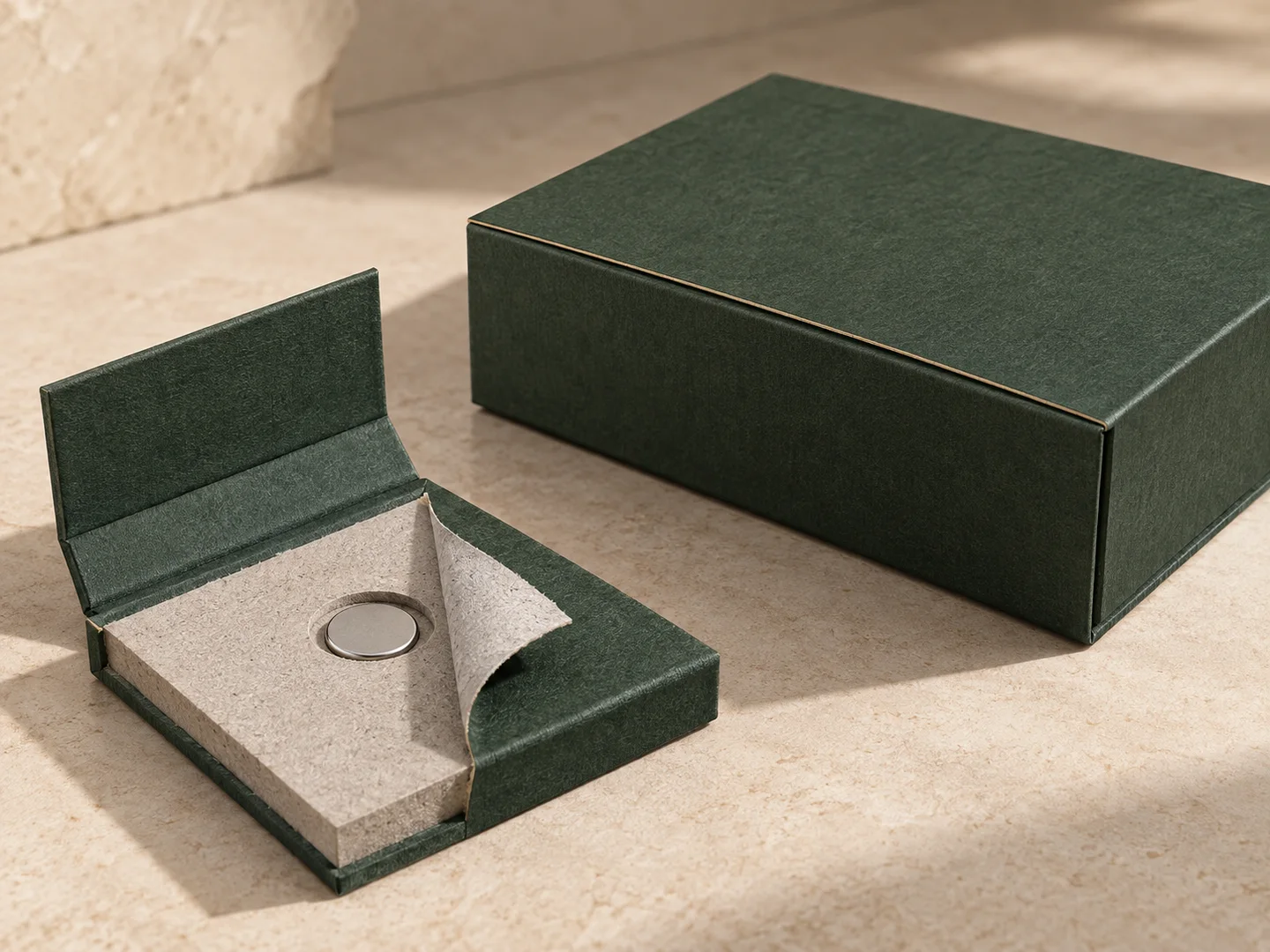
At a glance
Specify magnetic rigid box closures properly: understand air-gap pull loss across wrap paper, magnet-to-steel vs magnet-to-magnet pairs and flap bounce.
Buyers occasionally specify a magnet diameter from a generic online catalogue expecting several kilograms of holding power, only to find the box lid opens if tilted. Catalogue pull ratings are typically measured with a bare neodymium disc pressed directly onto a thick, flat steel plate with zero air gap. In a rigid box, two layers of wrapping paper (120–157 gsm each), lamination film, glue lines and tiny recess depth tolerances sit directly between the magnet and its target.
As magnetic engineering resources from Arnold Magnetic Technologies emphasize, magnetic flux density and attraction drop steeply as separation distance increases or when a thin steel strike plate saturates. A combined 0.4–0.6 mm paper-and-glue air gap can reduce real-world pull force substantially compared with direct metal-to-metal contact.
Select magnet pairing, count and flap geometry around box width, board stiffness and whether the box ships assembled or flat-pack:
| Configuration | Pull behaviour | Production & assembly check | Best application |
|---|---|---|---|
| 2× small discs (e.g. 8–10 mm) + steel plates | Clean light snap; relies on flush seating | Fast assembly; steel plates cannot be reversed in polarity | Compact cosmetic, jewelry or single-item book boxes |
| 3× discs or bar magnets + steel plates | Distributes hold across wide lids (> 240 mm) | Check center alignment so outer corners do not curl upward | Wide PR kits, apparel sets and dual-bottle diffuser boxes |
| Magnet-to-magnet opposing pairs | Stronger attraction across thicker textured papers | Strict polarity QC needed on every tray; higher magnet cost | Heavy collapsible boxes or thick specialty-paper wraps |
If your project uses a collapsible (fold-flat) magnetic box, verify that the magnetic flap covers enough of the front wall (typically half to full depth) to counter outward corner tension, and compare closure stiffness with our book-style magnetic box design guide.
When reviewing a physical sample, inspect these four mechanical causes before simply asking the supplier for a larger magnet:
Load the finished wrapped sample with actual products, close the flap, and test three handling actions: (1) hold the box vertically by its spine and shake gently to check whether internal weight pushes the lid open, (2) open and close the flap 20 times to confirm the ribbon pull tab does not loosen and wrap paper over the magnets does not bruise or whiten, and (3) note that magnetic flaps are presentation closures rather than courier seals—confirm an outer sleeve, sticker seal or shipping outer carton separately. Explore custom rigid box options to compare hinged and two-piece formats.
Magnet-to-steel plates (a neodymium disc in the flap attracting a thin iron/steel disc in the front wall) are cost-effective and avoid polarity mismatch errors on the assembly line. Magnet-to-magnet pairs offer stronger snap at wider gaps, provided polarity orientation is strictly controlled during gluing.
In a collapsible (fold-flat) rigid box, folded corner gussets, thick wrapping paper at hinge lines or slightly oversized inserts can exert outward spring tension against the front wall. Unless the flap hinge allowance and magnet holding force exceed that spring-back tension, the flap lifts slightly.
From guide to product
Explore the opening, material and insert details for each design. These are options to review, not proof of a tested fit for your product.

Rigid gift boxes · Magnetic book box
Custom wrapping paper, colour and texture by sample
View structure & details →
Rigid gift boxes · Drawer box
Wrapping paper; sample to confirm texture
View structure & details →
Custom paper bags · Twisted-paper handle bag
Kraft shopping-bag paper
View structure & details →Payment Options
Available for confirmed production orders.
Available for eligible payments.
Available payment methods may depend on order value, project stage and transaction arrangements confirmed with MTT Packaging.
 Bank Transfer
 PayPal