EVA Foam vs Paperboard Inserts for a Diffuser Gift Set
Quick answer
Choose between EVA foam and paperboard inserts by defining what must stay in position, where the product can be supported and how it will be removed. Compare named material grades and complete structures, not just a soft sample against a stiff sheet. In MTT’s diffuser gift-box layout, the bottle and reed sticks occupy separate positions. That layout gives a useful starting point for an insert brief; the material choice needs the filled bottle, finished surfaces and intended shipping pack.
By Hugo He · Custom Packaging Consultant, MTT Packaging · Updated 2026-11-01
Packaging design reference. Final fit, materials and finish are confirmed on an approved sample.
At a glance
Compare EVA foam vs paperboard inserts for a diffuser gift set: support, removal, surface contact, assembly and the evidence to request before approval.
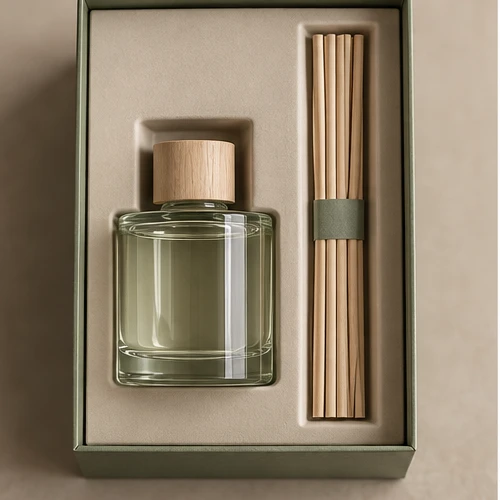
The MTT diffuser gift box places a short glass bottle beside a long reed bundle. The bottle cap and reed ends sit at different heights. Those differences matter before choosing a material: the bottle needs deliberate support, while the reed compartment needs to keep the bundle from migrating into the bottle space.
The visible cream surface does not identify the substrate underneath it. Use the pictured arrangement to discuss the geometry, then ask for a section drawing that names the insert material, facing and support below the bottle. A supplier should not quote EVA simply because the reference looks soft, or paperboard because its surface looks like paper.
02
Compare complete constructions, not material names
Two insert proposals for the same diffuser set
Decision
EVA foam proposal
Folded paperboard proposal
Bottle location
Cut cavity, depth and supporting base
Collars, folded supports and locking tabs
Product removal
Grip opening and resistance at contact points
Finger access without tearing a tab or lifting the deck
Surface contact
Foam grade, exposed cut edges and any facing
Cut edges, coating and folded contact surfaces
Packing work
Layers, bonding and placement in the box
Erection sequence, locks and orientation
End of use
Identify foam, facing and adhesive separately
Identify board, coating and attached components separately
Compare both proposals inside the same outer box using the same filled bottle. Otherwise a thicker base, a changed cavity or a different outer carton can be mistaken for a benefit of the material alone.
03
Ask for a grade and the properties relevant to its job
Zotefoams’ Evazote material range provides grade-specific technical information. Use manufacturer data to identify a candidate, then request the actual supplier’s grade and test conditions. “EVA insert” alone does not specify compression behaviour, thickness or the way a laminated construction behaves.
For a board proposal, record the grade, thickness, grain direction and folded geometry. Holmen’s technical information distinguishes grammage, thickness and stiffness; they are not interchangeable specifications. A flat sheet comparison also misses what a folded wall or collar contributes.
Do not prescribe a universal cavity allowance from the bottle’s nominal width. Include dimensional variation, surface decoration, assembly and a practical removal check in the sample review. The custom insert purchasing page covers the information needed to start that discussion.
04
Keep the cap out of the load path
In this arrangement, the wooden-look cap is prominent and tempting to grip. Specify whether the user should lift the bottle by its body instead. A finger opening can provide access without making the entire cavity loose. Check the cap connection with the product supplier; packaging should not assume it can carry the filled bottle.
Load the finished bottle and inspect contact at the base, shoulder and decoration. Close the box with the actual reed bundle and any card in place. Look for cap pressure, reed movement and a deck that lifts when the bottle is removed. Record which component moved and why. These observations are more useful than describing a sample as simply too tight or too soft.
05
Separate presentation fit from transport protection
A neat recess can locate a bottle without providing enough protection for a parcel journey. Assess the presentation box, its insert, any void fill and the outer shipping carton as one pack. Define the transport route and relevant test plan before claiming protection.
If a foam proposal is intended to cushion impact, ask the engineer which material data, support area and loaded mass informed the design. If a board proposal depends on folded supports, check that they remain engaged after the agreed handling trial. Neither material name establishes a drop-test result.
Ask for separate material references, tooling, assembly work and sample charges for each proposal. Confirm whether an insert arrives flat, assembled or already fitted in the gift box. Include any facing and adhesive in the specification rather than leaving them hidden behind a unit price.
Keep the bottle, reed bundle and outer box versions identical across the comparison.
Record where each component is supported and how it is removed.
Photograph contact marks and any movement after the agreed checks.
Retain the accepted insert drawing and material reference for reorders.
Check local disposal routes before making a recyclability claim for the finished combination.
Choose the proposal that meets the documented brief. A lower material cost can be offset by packing work; an attractive facing can introduce a separate contact or sorting question. Neither needs a generic winner.
From guide to product
Compare packaging for your brief
Explore the opening, material and insert details for each design. These are options to review, not proof of a tested fit for your product.


 Bank Transfer
 PayPal