Paperboard vs Molded Pulp vs EVA: Choosing Custom Inserts
Quick answer
Choose a custom insert by the product’s support needs, packing method and acceptable contact, then compare material routes. A folded platform, molded support and foam cavity can solve different problems. Test the final assembled insert, including any covering. Material names and visual neatness alone cannot establish retention or protection across the intended product range.
Measure the assembled product and identify contact areas
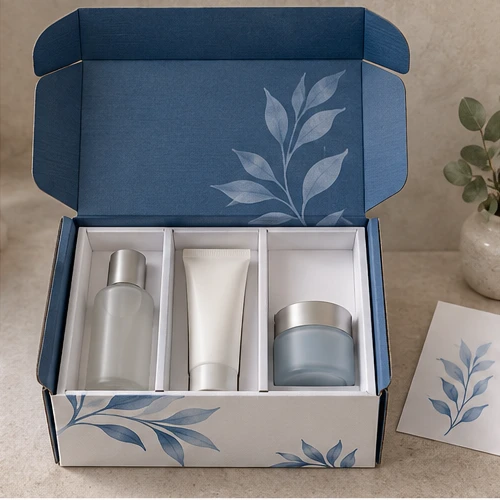
Provide dimensions with caps, pumps and decorations fitted, plus filled weight and photographs from several sides. Mark surfaces that should not be rubbed or loaded. Define whether the product lies down or stands up. A jar and two bottles, as in the skincare set, need separate positions and a review of lid clearance. Do not size a cavity from a photograph or nominal bottle capacity.
02
Paperboard: folded support with deliberate contact points
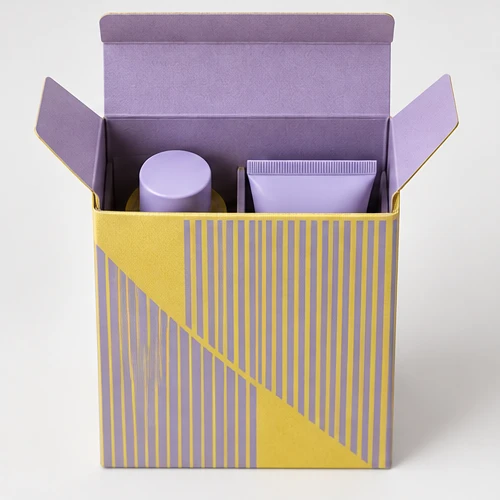
Folded or die-cut paperboard can create platforms, dividers and locating features. Specify where the product rests and how it is restrained; an attractive empty cutout does not prove support. Review creases, assembly and loaded deformation on the sample. Check the full material combination and local collection route before making recyclability claims. The carton example uses paperboard support, with grade and fit still to be confirmed.
03
Molded pulp: formed geometry and a tooling decision
Molded-fibre inserts can form three-dimensional support around a product. Surface appearance and dimensional behaviour depend on the process and material. Confirm the tooling scope, sample method and product contact areas before selecting it for appearance alone. Read the molded-pulp guide for cosmetics alongside your actual product requirements.
04
EVA and covered support: specify the full build
Cut foam can form locating cavities, but foam type, density, thickness and the remaining material between cavities need review. A fabric cover changes the contact surface and usable fit. Check for rubbing, lint, adhesive visibility and removal force. In the ring keepsake layout, the fabric-lined slit must suit the ring and its setting; the lining is not automatically an anti-tarnish material.
05
Access can matter as much as a tight fit
Allow a practical grip, finger recess or secured lift ribbon. A cavity that holds an item but makes removal awkward is not finished engineering. For a drawer, check stability during sliding; for a hinged lid, check the closing sweep; for a lift-off lid, check the full height under the cap. Use the opening guide to coordinate the insert and box.
06
Validate the full pack and record the approved version
Use actual contents to check loading, removal, closure and the intended handling sequence. Confirm the transport test scope for the complete pack separately. Record material, cavity drawing, product revision and approved sample together. If the bottle or cap changes, review the fit again. Send the product data for an insert review; include quantity, destination and any direct-contact requirements.
Is EVA always the safest insert for glass?
No material name establishes protection on its own. Geometry, support, material properties and the complete shipping pack need a loaded-sample review and appropriate testing.
Can one insert hold a whole gift set?
Yes, if each item has suitable support and removal access. Include every item, leaflet and accessory when defining the available space.
Is a paper insert automatically recyclable?
Do not assume that. Review coatings, adhesives, combined materials, separation and the actual collection route in the destination market.
From guide to product
Compare packaging for your brief
Explore the opening, material and insert details for each design. These are options to review, not proof of a tested fit for your product.


 Bank Transfer
 PayPal