Book-Style Magnetic Box Design: Hinge, Closure and Fit
Quick answer
A book-style magnetic box is a hinged rigid structure: its cover swings from the spine and closes at the front edge. Approve the hinge movement, finished panel stack, magnet alignment and loaded insert together—not as separate details. MTT’s chocolate portfolio example shows nine compartments in a charcoal and champagne box. A separate anonymised quotation records a 24-piece layout but leaves final fit and closure subject to approval.
By Hugo He · Custom Packaging Consultant, MTT Packaging · Updated 2026-11-08
Packaging design reference. Final fit, materials and finish are confirmed on an approved sample.
At a glance
Plan a book-style magnetic box around the hinge, finished wrap, closure registration and loaded insert. See the MTT chocolate portfolio example and a quotation-stage specification with checks still pending.
In a book-style magnetic rigid box, the lid remains attached at the spine and swings open; concealed magnets bring the front edge back to the base. UNIDO’s rigid-box style reference uses the term hinged cover for an attached lid.[1] Suppliers may use overlapping names for book-style and flip-top formats, so show the opening direction on the brief or provide a reference image. State which panel is the spine, which edge closes, and whether the lid opens left-to-right or upward.
This decision affects the printed panel sequence, space needed to open the box, product access and where the insert can sit. It is different from a two-piece box with a removable lid: compare the separate lift-off lid fit guide before choosing.
02
Start with the documented MTT chocolate layout
The MTT-R0203 chocolate selection box is a portfolio reference: a magnetic book structure with nine equal positions for wrapped chocolates, pearlescent wrapping paper, matte print and restrained spot gloss. The visible product image shows the open cover and compartment layout. The product record does not publish finished dimensions, board caliper, magnet force or a transport-test result; those should not be inferred from the picture.
A separate anonymised MTT quotation-stage example considered 24 chocolates in a 6 × 4 layout. Its quoted outer size was 240 × 170 × 35 mm, with 180 gsm C2S wrap, 1200 gsm one-side-white greyboard and a 350 gsm white paperboard lattice. It was a quotation record, not a completed order or approved sample; final dieline, closure and product fit were still pending. The figures describe that separate brief only and are not specifications for MTT-R0203. Read the paper grammage versus board-thickness review for why grammage does not establish caliper.
03
Review the spine as a wrapped moving joint
The spine has to bend while the cover and base stay aligned. On the assembled sample, inspect the hinge from closed through its full intended opening: the wrap should not split, lift or abrade where the panels turn, and the cover should not twist as it moves. Check the inside lining and wrapped turn-ins too; their layers contribute to the finished stack around the fold.
Do not copy a nominal hinge gap or board thickness from a different box. Board caliper, wrap, liner, panel construction and opening angle all affect movement. Mark the current sample revision and record the exact material set. If a finish or wrap changes, recheck the fold because the surface layer at the spine has changed.
04
Align the closure after the final wrap is defined
Magnets hidden under the paper only meet reliably when their positions and the wrapped panels register. Confirm the closure location on the finished sample, after the wrap and lining are applied. Check that both sides meet evenly, the lid remains seated without a visible twist, and the user can open it without pulling on a fragile edge or the insert.
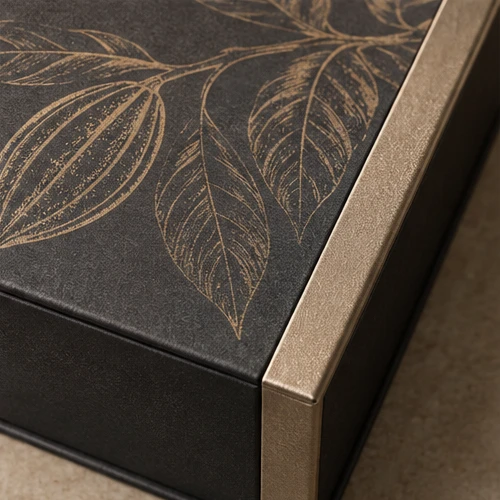
Detail view from the MTT-R0203 portfolio reference. The concealed closure itself is not visible in this photograph.
What you observe
First checks
Do not assume
One corner lifts
Box squareness, panel alignment and closure registration
That a stronger magnet alone will correct the geometry
Cover rubs at the spine
Hinge movement, wrapped layers and panel clearance
That the outside dimensions reveal the hinge gap
Closing feels uneven
Left/right seating, finished layer stack and sample revision
A universal magnet count or pull-force value
Product touches the lid
Loaded product height, insert depth and inner lid build
That the magnet is the cause of a height conflict
No universal magnet quantity, position or opening force is specified in the MTT records cited here. Put those decisions through structural development and confirm the result with the actual wrap and loaded product, rather than treating a catalogue image as a closure specification.
05
Check the insert and actual product as one assembly
Lay out the product first, including wrappers, caps, labels or accessories that change its finished envelope. For multiple positions, label each cavity and show whether dimensions refer to clear openings or to divider centre-lines. Then check the loaded sample for lid clearance, movement between partitions, finger access and removal without damaging adjacent pieces.
MTT’s chocolate example is specified for wrapped pieces. Direct food contact would need a separately specified suitable food-contact component and supporting documentation; the rigid gift box itself is not evidence of food-contact compliance. For non-food sets, the skincare book-box layout shows a different arrangement with one jar and two bottle positions. Its cavity arrangement should not be transferred to another product without measurement.
06
Separate presentation approval from transit validation
Opening and closing checks establish presentation behaviour; they do not establish parcel or distribution protection. ISTA explains that performance testing applies to a specific packaged-product system and that test selection depends on the actual distribution environment.[2] If the box will ship, define the complete pack separately: loaded presentation box, protective components, outer carton, route and handling conditions. Do not describe the MTT portfolio image or quotation as transit-tested.
On the sample approval sheet, record the product revision, material list, insert layout, wrap/finish, closure observations, open/close condition and any agreed transport-test scope. The sampling review guide covers the wider approval sequence.
Approve the opening direction and closed-box orientation.
Measure the actual product and loaded arrangement; mark unknowns as pending.
Review the wrapped hinge and front closure on the finished assembly.
Load the real product and check clearance, retention and removal access.
Approve transit performance separately for the complete packaged product, if required.
MTT evidence: public catalogue record MTT-R0203 and an anonymised quotation-stage layout described in MTT’s grammage and board-thickness review. Quotation data are not an approved production specification.
From guide to product
Compare packaging for your brief
Explore the opening, material and insert details for each design. These are options to review, not proof of a tested fit for your product.




 Bank Transfer
 PayPal