Paper GSM vs Board Thickness: An MTT Quotation Case
Quick answer
Paper GSM measures mass per area; thickness measures the distance between the sheet surfaces. They answer different buying questions. In an MTT chocolate-box quotation, three components had separate GSM specifications, while their thicknesses and final product fit still needed confirmation. For a rigid box, request the grade and measured caliper of each component, then check the assembled sample with the actual contents. A GSM-to-millimetre conversion alone cannot approve the fit.
By Hugo He · Custom Packaging Consultant, MTT Packaging · Updated 2026-10-25
Packaging design reference. Final fit, materials and finish are confirmed on an approved sample.
At a glance
An MTT chocolate-box quotation shows why paper GSM cannot establish board thickness, divider fit or usable space. See what to confirm before sampling.
The MTT case: three materials, three separate specifications
An anonymised MTT quotation dated 6 October 2026 describes a book-style hinged rigid box for 24 chocolates in a 6 × 4 arrangement. The quoted external dimensions were 240 × 170 × 35 mm. The material lines distinguish the printed wrap, structural board and lattice insert:
Component
Documented quotation specification
Still to confirm
Printed wrap
180 gsm C2S art paper; CMYK printing and anti-scratch matte lamination
Actual paper grade and finished layer thickness
Structural board
1200 gsm one-side-white greyboard
Board caliper and construction details
Lattice insert
350 gsm white paperboard
Caliper, slots, clear cavities and fit with chocolate cases
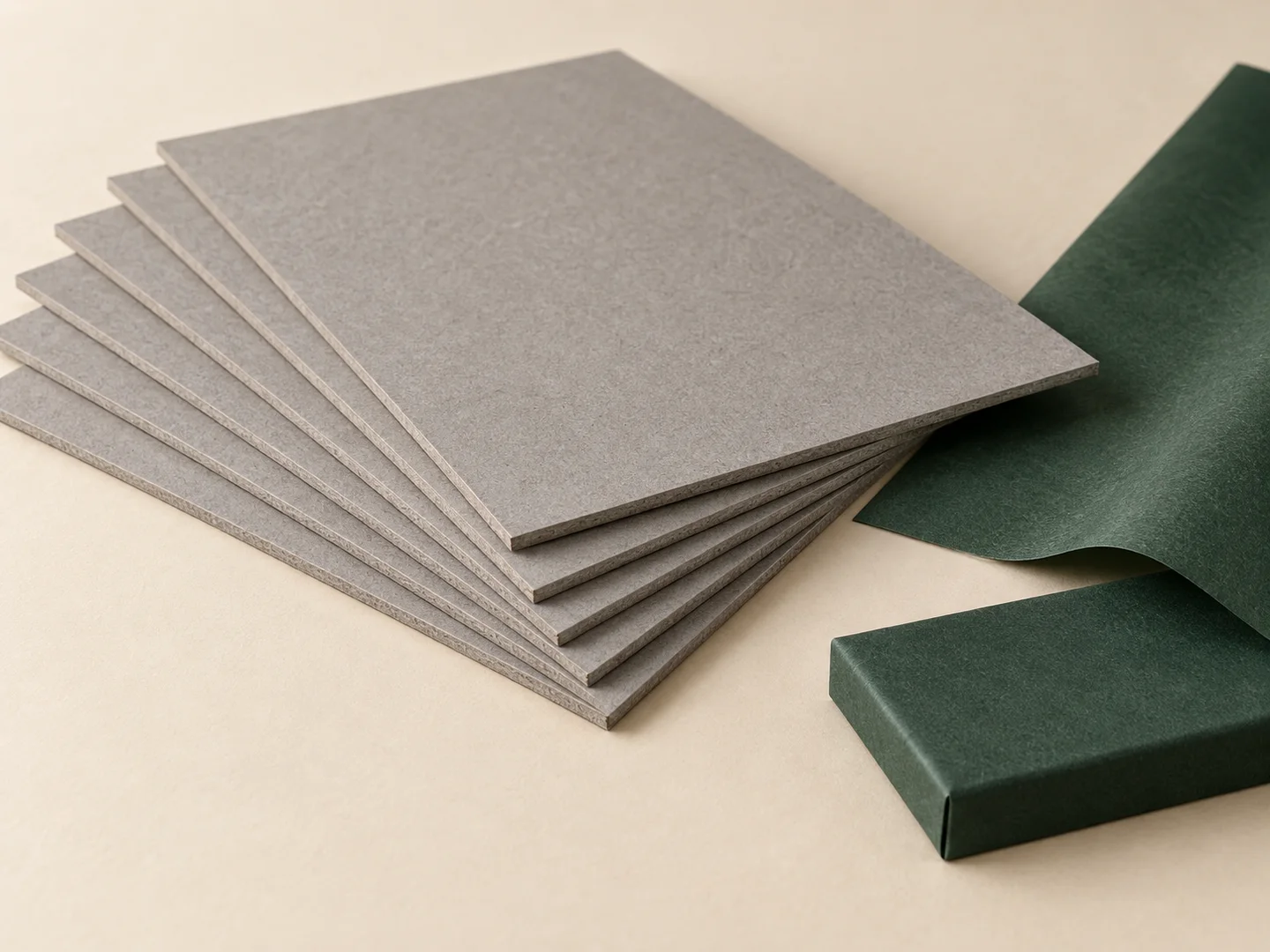
Project stage: this is a quotation record, not a completed production or performance-test report. Final dieline, closure and product fit required approval. No measured thickness or sample acceptance is established by this record. The illustration above is a general material illustration, not a photograph of this project.
02
What GSM and thickness tell a packaging buyer
GSM means grams per square metre, written g/m². It describes how much a given area weighs. Caliper describes sheet thickness, normally recorded in micrometres (µm) or millimetres (mm). ISO treats them as separate measurements: ISO 536 covers grammage, while ISO 534 covers thickness, density and specific volume.
The missing link in a universal conversion is the material's density or bulk. Papers with different fibre structures, coatings and compression can have different calipers at the same grammage. A quoted 1200 gsm greyboard therefore does not establish a specific millimetre thickness. Adding 180 gsm wrap to 1200 gsm board does not calculate finished wall thickness either.
For the broader choice of structural board and decorative wrap, use the board and wrapping-paper guide. This article addresses the narrower measurement problem.
03
Use a named grade data sheet, not a universal conversion chart
Holmen's published Invercote G technical data sheet lists 350 g/m² at a nominal thickness of 465 µm, or 0.465 mm. It gives separate grammage and thickness tolerances of ±4%, with ISO 536 and ISO 534 as the respective methods. These are supplier specifications, checked on 25 October 2026.
That figure belongs to Invercote G. The MTT quotation says only “350 gsm white paperboard” for the lattice; it does not identify Invercote G. We cannot assign 0.465 mm to the quoted insert or claim that this paper grade was used. The useful next step is to obtain the selected grade's own data sheet and confirm the sample material.
Keep both nominal caliper and the agreed tolerance in the specification. A nominal value helps start the design; sample measurements and fit checks decide whether that design works.
04
Why the distinction matters in this 24-cavity box
External size does not give usable space. The 240 × 170 × 35 mm figures describe the quoted outside dimensions. The internal space depends on the board, wrap, lining, joints and closure construction. Subtracting an assumed greyboard thickness would create an unverified cavity size. See how to specify internal and external packaging dimensions.
Divider thickness occupies space across the grid. The record mentions approximately 35 mm square cavities as a customer suggestion, with final clear dimensions still subject to approval. For a 6 × 4 layout, specify whether a dimension refers to the clear opening or divider spacing. A change in divider caliper can affect several openings and slot joints. Check the layout as a complete assembly rather than approving one loose strip.
The wrapped chocolate needs its own clearance. The quotation calls for checking pieces or cases approximately 30 mm in size. The paper case, loading orientation and lid clearance still matter. A heavier insert is not evidence that the product will fit or be easier to remove.
05
A material confirmation checklist before sampling
Name each component. Keep structural greyboard, outer wrap, lining and insert on separate specification lines.
Record grade, GSM and caliper. Identify the supplier's grade and agreed thickness tolerance. Mark missing measurements as pending.
Define where dimensions are measured. Separate external box size, clear internal space, divider pitch and clear cavity size.
Measure and assemble the selected materials. Agree the measurement method and conditions. A quick workshop reading should not be presented as an ISO test unless the specified method was followed.
Load the actual contents. Check all positions with the intended chocolate cases, close the lid, and review loading and removal. Record changes before approving the final dieline.
Keep a revision reference. Link the material specification, drawing and approved sample. If the grade or caliper changes, review affected fit and construction before substituting it.
These are proposed approval checks for this quotation-stage case, not a claim that MTT has already performed them. The sample approval guide explains the wider approval sequence.
From guide to product
Compare packaging for your brief
Explore the opening, material and insert details for each design. These are options to review, not proof of a tested fit for your product.




 Bank Transfer
 PayPal