Rigid Drawer Box Design: Fit, Insert and Ribbon Pull
Quick answer
For rigid drawer box design, approve the sleeve, loaded tray and pull together. An empty drawer that slides freely can behave differently once the insert and products are fitted. In this MTT quotation for 24 truffles, the 220 × 160 × 30 mm external size was specified, while the usable capacity, drawer clearance and pull detail still required sample approval.
By Hugo He · Custom Packaging Consultant, MTT Packaging · Updated 2026-10-26
Packaging design reference. Final fit, materials and finish are confirmed on an approved sample.
At a glance
An MTT 24-truffle quotation shows what to check in rigid drawer box design: sleeve fit, loaded height, insert clearance and the fabric pull.
The quoted box: 24 truffles, with the fit still open
Our 7 October 2026 quotation called for an assembled rigid drawer box: an outer sleeve, a sliding tray and a paperboard insert for 24 truffles. The outside measured 220 × 160 × 30 mm on the quotation. The same record left the insert layout, usable capacity and drawer clearance to be checked against the truffles and their liners before production.
That distinction matters. The outside size describes the package the buyer receives. It does not tell the packer how much room remains above a chocolate or beside the insert.
Item
Recorded in the MTT quotation
Decision still required
Finished outside
220 × 160 × 30 mm
Usable internal space with all components fitted
Wrap and lining
157 gsm C2S coated paper
Finished build and opening behaviour
Rigid core
1200 gsm double-grey greyboard
Actual caliper and assembled dimensions
Insert
Paperboard, for 24 truffles
Grammage, cavities and fit with the liners
Opening detail
Fabric pull
Attachment and final sample detail
This is an anonymised quotation-stage case. The available record does not establish an approved sample, completed production or measured opening performance. Customer identity and commercial prices are withheld.
02
Three places a drawer can catch
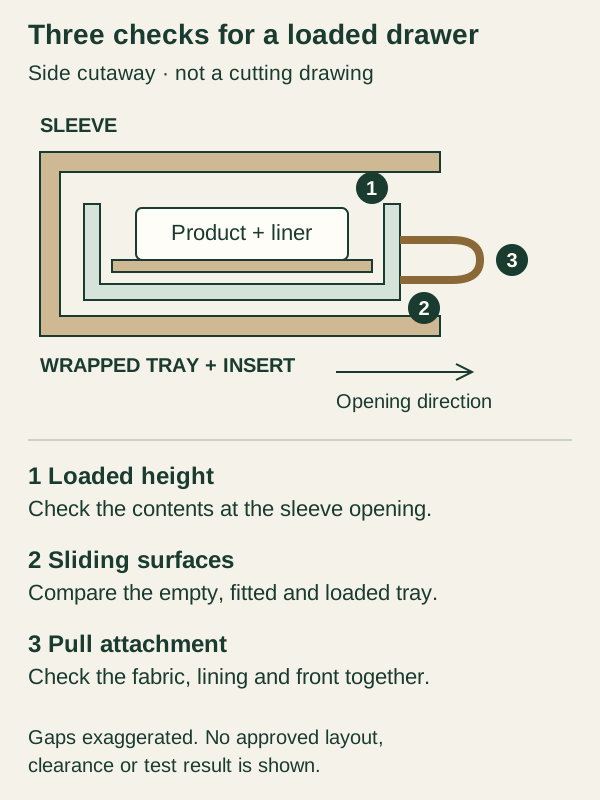
Start with the sleeve and tray. Check the finished wrapped surfaces, especially the sleeve mouth, corners and paper joins. If the tray catches at one point, find the contact mark before increasing every dimension. A local overlap and a tray that is too large need different corrections.
Next, fit the insert. It should stay seated without pushing the tray walls outward. Then load the contents with the intended liners. Check whether anything rises into the sleeve opening as the drawer moves; a fit check on the empty box misses that contact.
MTT engineering schematic, not the project cutting drawing. The gaps are exaggerated to identify inspection points; no clearance value or approved cavity layout is implied.
For this 24-truffle brief, we would check the tray first without the insert, then with the insert, and finally with the truffles and liners. Keeping those observations separate helps identify which component needs a revision.
03
Why we have not supplied a universal clearance
The quotation gives board weight, but not enough information to calculate a finished sliding gap. The wrap, lining, joints and actual board thickness all need to be represented in the sample. Our GSM and thickness case explains why a grammage line cannot be used as a caliper measurement.
Humidity is another reason to record how a sample was checked. RISE describes moisture-driven dimensional changes in paper and paperboard, including curl and waviness.[2] A drawer comparison made under different conditions may therefore need investigation before the drawing is changed.
For its paperboard printing and converting guidance, Holmen recommends 45–60% relative humidity and 20–23°C to help prevent curl and misregistration.[1] Those are the manufacturer’s processing recommendations, not a storage specification for the chocolates, a drawer tolerance or evidence that Holmen board was used in this MTT quote.
Agree the sample conditions with the converter and record them. We would approve an opening range using the final materials and representative loaded samples, rather than promise one gap for every drawer box.
04
Pull the tray where the customer will pull it
The quote specifies a fabric pull but leaves its detail to sample approval. A decorative ribbon shown in artwork is not enough to settle the attachment.
On the sample, pull from the position a customer can actually reach. Check whether the tray moves straight, whether the attachment lifts the lining and whether loose fabric catches inside the sleeve. Keep the intended contents in place while checking. If the pull bends or tears the front before the drawer moves, first investigate the resistance and attachment together.
Record the attachment detail, visible length and agreed opening checks on the sample sheet. A pull-force measurement or repeated-opening result belongs there only after it has been measured. Neither is available for this quotation.
05
Keep a short fit record beside the approved sample
Check
Record before release
Sample identity
Drawing revision, material references and date
Empty tray
Where resistance begins; rubbing or corner contact
Insert fitted
Wall distortion, seating and movement during opening
Complete pack
Truffle and liner dimensions, loaded height and contact at the sleeve mouth
Fabric pull
Attachment, access and observations from the agreed opening check
Decision
Accepted details, required changes and who confirms the next sample
Food-contact barriers and liners were also left for approval in the quotation. Resolving the drawer fit does not resolve that suitability question. Keep it as a separate approval item for the actual materials and intended use.
The sample approval checklist covers the wider approval record. Transport protection also needs its own review of the complete packed unit and outer carton; smooth drawer travel is not a shipping test.
06
Sources and image notes
Case data: MTT quotation dated 7 October 2026, checked against its construction, material, dimensions and fit-approval entries. The quotation supports the specification and outstanding decisions, not a completed project outcome.
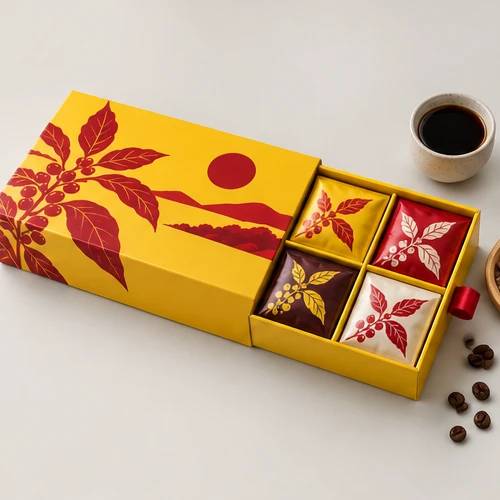
The opening image is a general drawer-box illustration. The cutaway identifies proposed inspection points. Neither is a photograph of this customer’s sample or proof of an approved design.
From guide to product
Compare packaging for your brief
Explore the opening, material and insert details for each design. These are options to review, not proof of a tested fit for your product.




 Bank Transfer
 PayPal