Choosing Board and Wrapping Paper for a Premium Box
Quick answer
Select the structural board and visible paper separately. The board must suit the box span, contents and opening; the wrap must suit the colour, touch and finishing you want. Compare samples of the complete combination. A heavier board or a textured paper can introduce new folding, wrapping and fit problems rather than automatically improving a premium box.
A broad lid and a compact ring box present different stiffness problems. We would check panel span, loaded weight and how the customer lifts the box before discussing thicker board. More thickness also changes mating sizes, wrapped corners and hinge allowances. Approve those details together rather than substituting board late in production.
02
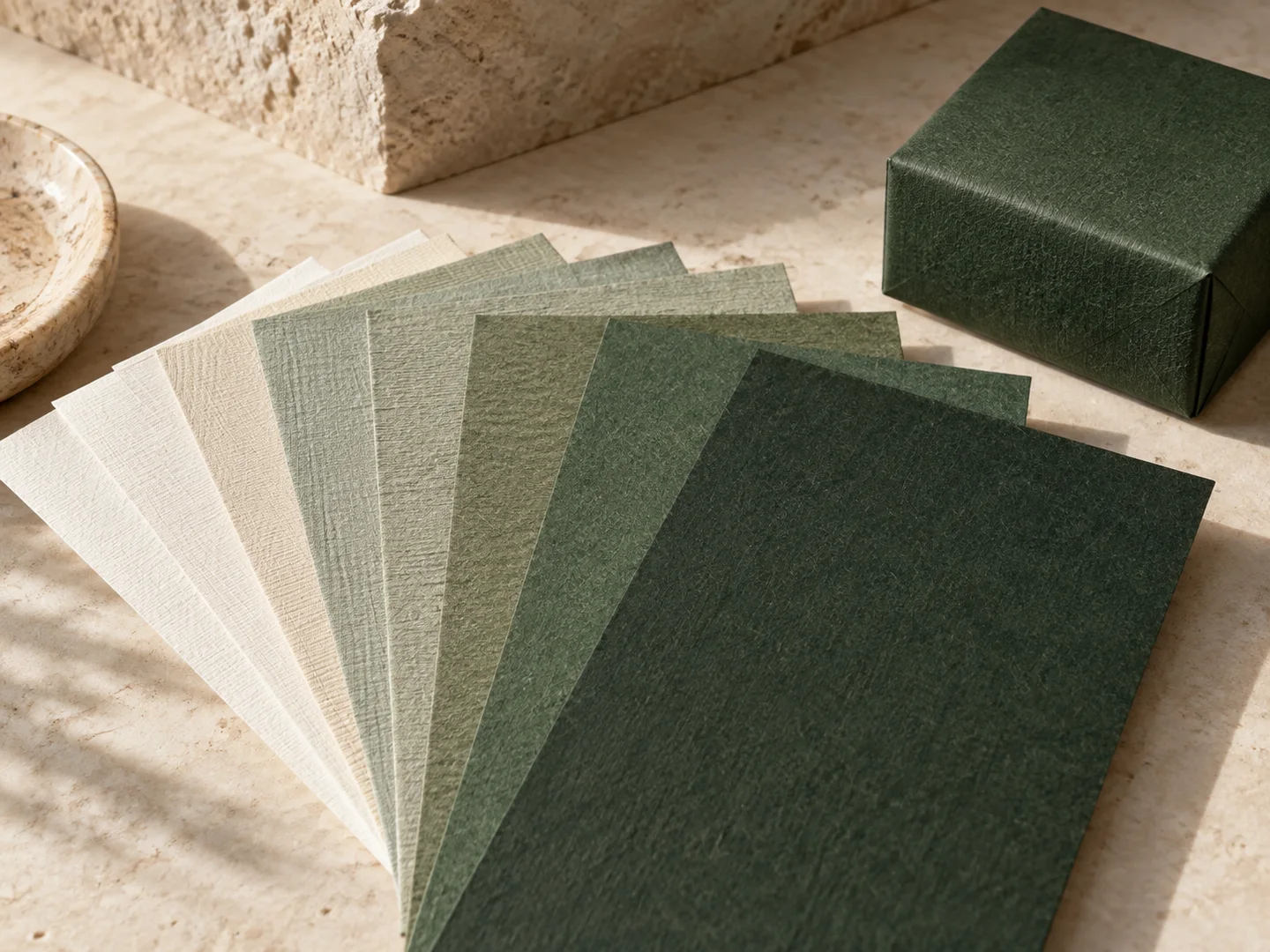
Match the wrap to the artwork
Smooth coated paper and textured uncoated paper can give the same artwork very different colour and foil results. For a fine metallic border, ask for a proof on the intended stock before committing to an entire box. For a large dark surface, inspect handling marks and edge appearance. A small swatch cannot establish the look of a broad wrapped panel.
03
Compare the complete material stack
Structural core: grade, thickness and agreed stiffness requirement.
Visible wrap: stock reference, colour and finishing.
Liner and adhesive: assembled appearance and compatibility.
Insert: fit with its final covering in place.
Keep the sample specification attached to the approval so a similar-looking replacement is not treated as identical.
04
Check sourcing claims separately from appearance
Brown colour does not establish recycled content, and a paper-based pack is not automatically recyclable everywhere. For an FSC claim, confirm the applicable certified supply chain and claim documentation rather than relying on a stock name. See FSC chain-of-custody guidance. MTT certification is not asserted here.
05
Choose what the sample needs to prove
Compare corner wrapping, lid fit, rub marks and foil detail using the intended contents. If changing the wrap changes friction, repeat the opening check. For terminology across cartons and corrugated packs, use the material specification guide.
From guide to product
Compare packaging for your brief
Explore the opening, material and insert details for each design. These are options to review, not proof of a tested fit for your product.



 Bank Transfer
 PayPal