Recycled vs Recyclable Packaging Boxes: A Buyer’s Guide
Quick answer
Recycled packaging describes material inputs; recyclable packaging describes a possible end-of-life route. Buyers should assess them separately. Define whether each claim covers the board, wrapping paper, insert or complete box, then request evidence for that boundary. A recycled-content statement does not establish recyclability, and a recyclable design does not tell you how much recycled material it contains. Review the destination market and the finished construction before approving public wording.
Recycled content asks what went into a material. Recyclability asks what can happen to the used packaging in an applicable collection and recycling system. A purchasing team can pursue both objectives, but approving one does not approve the other. Nor does either establish that the complete packaging has a lower environmental impact than an alternative.
For a rigid gift box, separate the structural board from the wrapping paper, insert, closure and accessories. The board may have documented recycled content while the wrap has a different specification. A statement covering the board cannot automatically describe the complete box, much less a set that also includes a ribbon, shopping bag and product.
Start the brief with two fields: the recycled-content requirement and the intended end-of-life objective. Add the destination market.
02
Define what the percentage covers
Before comparing recycled-content figures, ask for the material name, component, stated percentage, calculation basis and supporting document. Record whether the supplier distinguishes pre-consumer and post-consumer material. Do not infer that distinction from the colour of a paper sample or from a description such as natural kraft.
The denominator is the most easily overlooked part. Is a percentage based on the fibre in the wrapping paper, the mass of the board, or the complete assembled packaging? These are different boundaries. Ask the supplier to write the boundary in the quotation and material schedule, including any excluded components.
An illustrative comparison shows the problem. One quotation specifies recycled content for the greyboard; another specifies it for a paper insert. Neither figure tells the buyer which complete box has more recycled material. Keep the claims separate until a comparable calculation is available.
03
Build a small evidence table
Use one line per component rather than one environmental description for the order. The list should include structural board, wrap, liner, insert and separate bag.
For each line, record: material reference; recycled-content statement and scope; document reference; recycling question still open; approval owner. A blank cell means unknown, not zero and not accepted.
Documents should identify the material actually proposed for the order. Keep the approved material reference with the purchase specification.
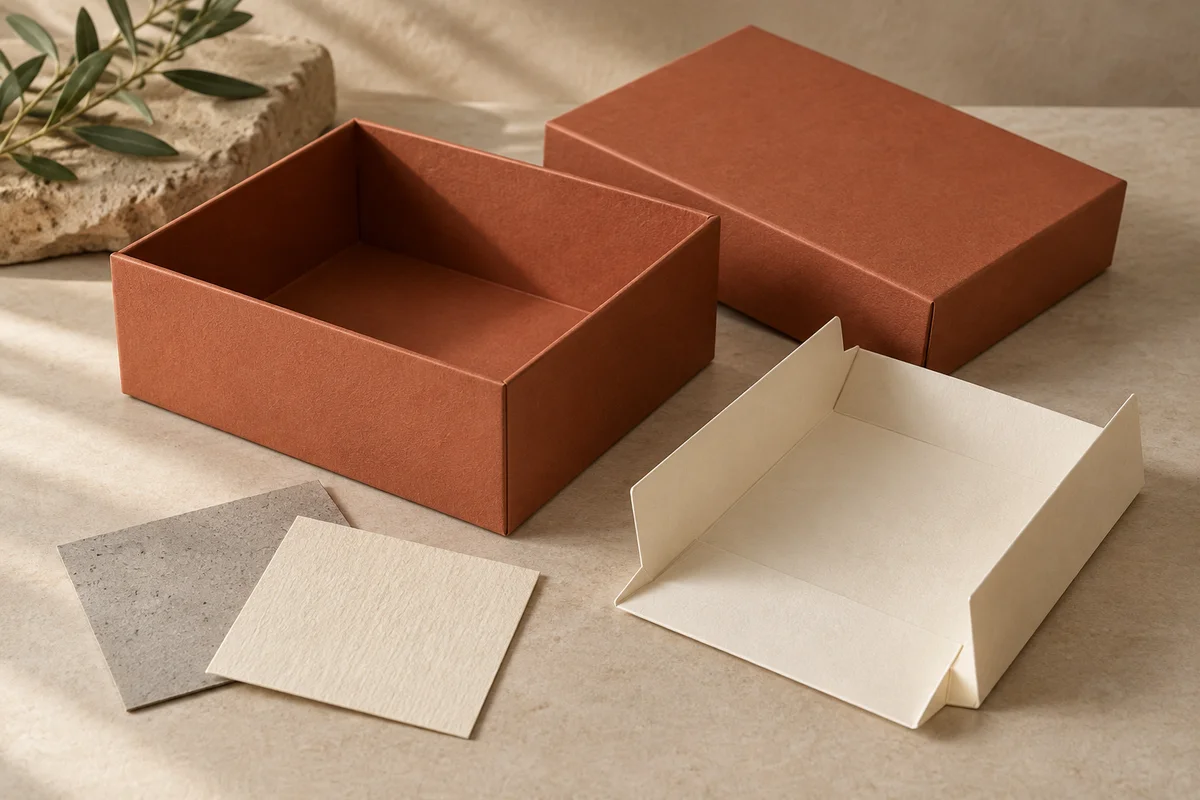
Illustration: terracotta box, separate paperboard tray and paper material swatches.
04
Treat recycling as a finished-construction question
A rigid box combines materials through wrapping, gluing and decoration. Review the actual construction and the intended disposal sequence. A removable tray can be assessed separately from a bonded tray, but removability alone does not prove that either component is accepted by a local system.
The 4evergreen Circularity by Design Guideline addresses conventional, flotation-deinking and specialised recycling pathways. That distinction is a useful reminder to identify the relevant process rather than assuming one universal route for paper packaging. The guideline is a design reference, not a certificate for a particular box.
Ask whoever supplies recycling evidence to identify the specimen and its limitations. Does the assessment cover the decorated box, only its paper, or a different construction? If the insert, coating or closure changes, decide whether the existing evidence still applies. Check collection acceptance for the intended market separately from material behaviour in a test.
05
Keep purchasing language separate from pack copy
An internal target can be provisional: request a documented recycled-content option for the structural board. A printed claim is a public statement about a defined item. Do not transfer wording from an early quotation into artwork without confirming its scope and support.
For US-facing claims, the FTC Green Guides summary calls for qualification of partial recycled-content claims and recyclable claims where appropriate facilities are not sufficiently available. It also cautions against broad, unqualified environmental benefit claims. Review the requirements of each destination before approving pack copy.
A useful approval record keeps the proposed wording beside its evidence, component boundary and target market. If the evidence only concerns the insert, name the insert. Avoid allowing a paper-related statement to appear as though it describes the bottle, cap or complete gift set.
06
Compare equivalent packaging, not only material descriptions
Keep the same product, packing quantity and protection requirement when comparing proposals. A change in board or paper can require another assessment of appearance, folding, wrapping and fit.
For a perfume presentation box, review bottle support and removal with the intended insert. For a jewellery box, inspect the contact surfaces and the way small items are retained. Ask for representative samples and agree acceptance criteria before choosing on the strength of an environmental description alone.
The custom insert options page provides a starting point for discussing support geometry. A lighter insert that cannot hold the product securely is not an equivalent proposal. Equally, adding material without a defined protective function deserves review. Record the reason for each structural choice.
07
Close the evidence gap before placing the order
The final purchasing question is whether the approved box and the approved statement refer to the same specification. Match the material schedule, sample revision, artwork and order documents. Assign an owner to any unresolved sourcing or disposal question, and set a decision point before production approval.
Use the finished-box approval checklist for the broader review of structure, protection and documentation. This comparison supplies the terminology and claim boundaries that belong inside that process.
Keep three outcomes available: accept the documented proposal, request a specific revision, or retain the material while withholding an unsupported public claim. That last option avoids forcing an evidence gap into a yes-or-no judgement about the physical packaging. The box can be evaluated on its actual performance while the environmental wording remains unapproved.
From guide to product
Compare packaging for your brief
Explore the opening, material and insert details for each design. These are options to review, not proof of a tested fit for your product.



 Bank Transfer
 PayPal