Sustainable Luxury Packaging Boxes: A Sample Approval Checklist
Quick answer
Before approving a sustainable luxury packaging box, review the complete construction, product protection and evidence behind each environmental claim. List every component, inspect a representative finished sample, confirm the intended recycling route and record unresolved questions. Paper-based materials, removable inserts and documented fibre sourcing answer different questions; none alone proves that the assembled box is recyclable or has a lower environmental impact.
A buyer evaluating sustainable luxury packaging boxes needs two approvals: the packaging must work for the product, and any environmental statement must match the evidence. A paper specification alone cannot answer both questions. The assembled box may also contain adhesive, surface film, an insert, a closure and accessories.
Start by stating the intended improvement. Are you reducing unnecessary material, replacing a mixed-material insert, specifying documented fibre sourcing, or improving separation after use? Record the destination market and delivery route alongside that objective. “Make it eco-friendly” leaves purchasing, design and quality teams with different definitions of success.
For an overview of project-dependent options, the MTT sustainability page explains the sourcing and material questions to raise. This checklist addresses the next step: deciding what evidence belongs beside the physical sample.
02
Make every component visible
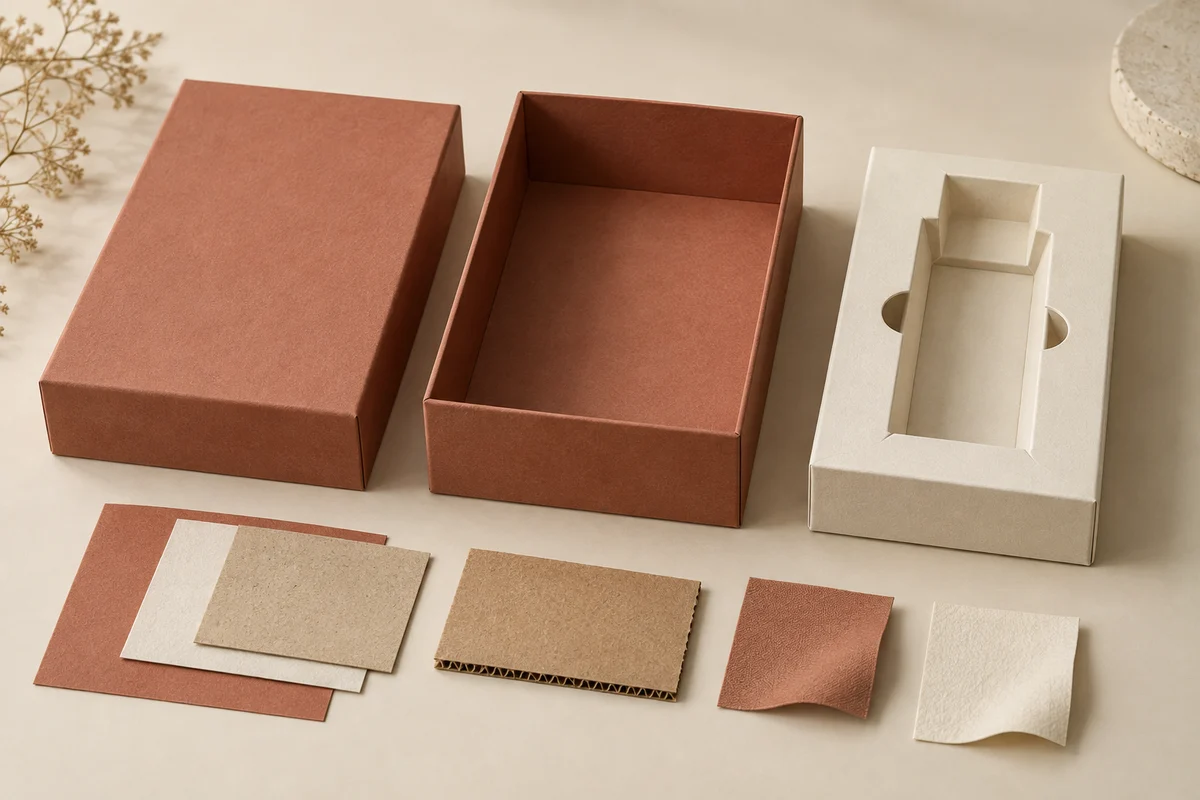
Request a component list for the exact sample revision. Include the structural board, wrapping paper, print, coating or laminate, adhesive, insert, magnets, ribbon and any separate card or bag. Identify which components are bonded together and which the user can remove. Ask for the relevant material specification rather than accepting a colour or marketing name.
A useful evidence sheet has four columns: component, proposed material, supporting document and unresolved question. For example, the insert entry might identify folded paperboard but still require its coating specification. The box entry might identify a fibre source while leaving the finished construction’s recycling route unresolved. Keep those gaps visible.
If recycled content is specified, establish which component the statement covers and the basis of the percentage. A claim about the board should not silently become a claim about the entire gift set.
AI-generated concept illustration of separate packaging components, not a tested specimen or a verified recycling claim.
03
Separate sourcing evidence from recycling evidence
FSC chain of custody certification concerns the identification and control of forest-based materials through the supply chain. Treat that evidence as a sourcing matter; it does not establish that a decorated box is recyclable in a buyer’s market. Ask for documentation appropriate to the actual supplier, product and proposed claim. Do not assume certification from a logo in a presentation.
For fibre-based design decisions, 4evergreen’s Circularity by Design Guideline, version 4 (2026), provides a reference for recycling-oriented design. Use it to frame questions about the selected construction and relevant recycling process, not to declare every paper box suitable for every collection system.
04
Inspect separation without confusing it with recyclability
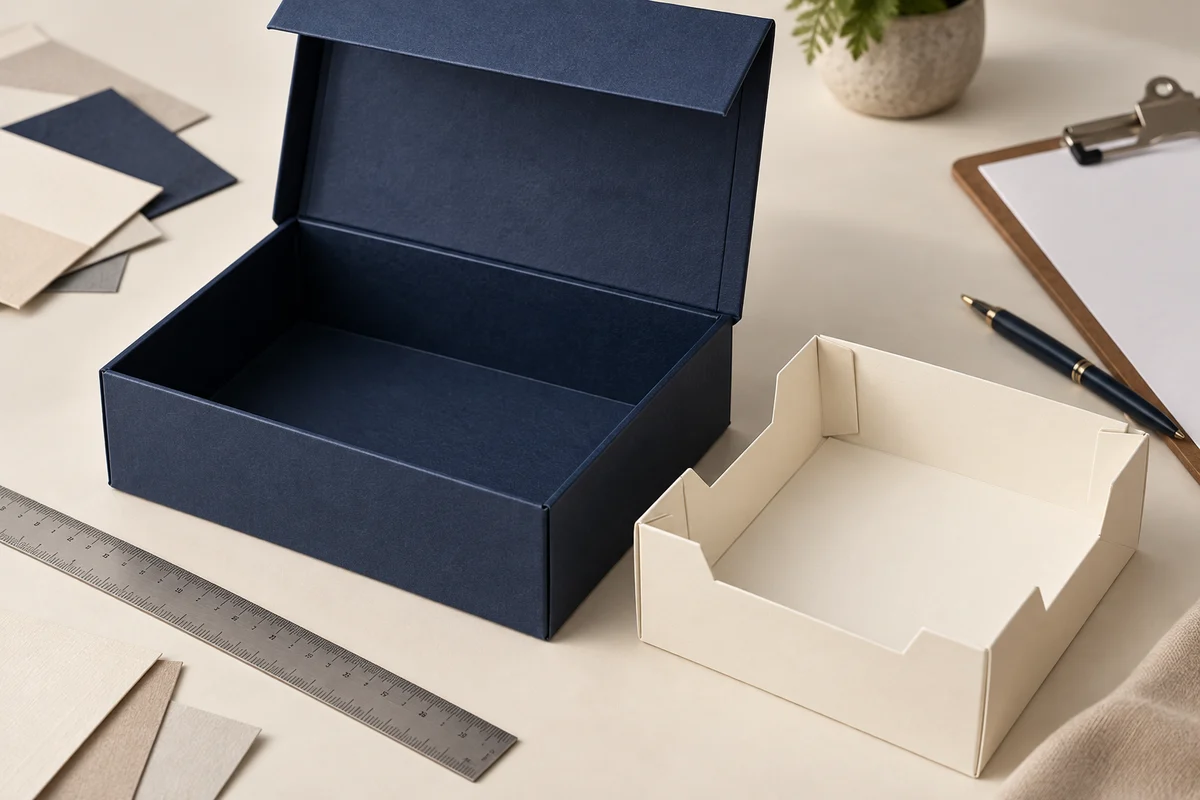
Open the sample and try the intended disposal sequence. Can the insert be lifted out without tools? Is a ribbon attached to the tray or embedded in the box? Does removing a decorative piece leave bonded layers behind? Photograph the steps and ask whether a consumer could reasonably identify them.
This is a practical design review, not a recycling test. A removable insert may make component separation easier, but that observation does not prove that either part is accepted locally. Equally, avoid a blanket rule that every coating or adhesive prevents recycling. Assess the actual specification and applicable route.
Cepi’s laboratory test method, version 3 (2025), defines a procedure for assessing relevant behaviour in conventional paper recycling processes. A laboratory result must be read within its method and specimen scope. It does not establish household collection access everywhere.
05
Protect the product before approving a material change
For a perfume bottle, check the actual bottle and closure against the insert, including base support, side movement, cap clearance and the way the product is removed. An insert that grips the cap but leaves the bottle poorly supported deserves redesign. Agree suitable fit criteria for the particular product rather than imposing an arbitrary universal tolerance.
If replacing foam with paperboard or moulded fibre, review the complete support geometry. A material substitution may require different walls, folds, contact points or clearances. The custom insert options page helps frame those alternatives.
Check assembly and packing with the people who will use the packaging. Then agree transport testing appropriate to the packed product and shipping route. A presentation box should not be treated as its own shipping container unless that use has been evaluated. Record results before accepting any claim of equivalent protection.
06
Approve the real finish and packed dimensions
Inspect a representative decorated sample, not only an undecorated structural mock-up. Request the proposed coating, adhesive and wrapping specification. Assess whether the finish remains acceptable during normal handling and whether corners, folds and contact areas need adjustment. Any change after approval should be documented.
Measure the assembled box, then confirm the shipping carton arrangement. A smaller presentation box may change the number packed per carton; a flat structure may need more assembly work at the destination. Compare the actual pack-out before claiming transport savings. Avoid converting a dimensional change into a carbon reduction without an appropriate assessment.
AI-generated sample-review concept, not an actual inspection, measurement record or tested specimen.
07
Write a decision the production team can use
Mark each approval item as accepted, awaiting evidence or requiring revision. Record the sample reference, artwork version, material list, agreed checks and owner of each open question. If changing the insert or finish later, identify which approvals need to be repeated.
Product fit and removal: reviewed with the actual product.
Materials and decoration: matched to the approved specification.
Shipping protection and pack-out: assessed for the intended route.
Sourcing and environmental statements: supported for their stated scope.
Open questions: assigned before production approval.
For US-facing marketing, the FTC’s Green Guides summary advises against broad, unqualified environmental benefit claims and explains qualifications for recycling claims. Other destinations need their own review. A specific supported statement is more useful than printing “eco-friendly” on an otherwise unexamined box.
Keep this record with the physical approval sample. It gives purchasing, design and production one reference when balancing appearance, product protection and the environmental objective.
From guide to product
Compare packaging for your brief
Explore the opening, material and insert details for each design. These are options to review, not proof of a tested fit for your product.



 Bank Transfer
 PayPal