Kraft Paper vs Recycled Paper Packaging: What to Specify
Quick answer
Compare the specified paper grades, not just the words kraft and recycled. A kraft description does not establish the recycled-content percentage, and a brown appearance does not identify the fibre source. For a skincare carton, request the board grade, thickness, recycled-content evidence and print sample, then check the folded box with the actual products. For a corrugated shipping box, identify the liners and fluting separately.
By Hugo He · Custom Packaging Consultant, MTT Packaging · Updated 2026-11-03
Packaging design reference. Final fit, materials and finish are confirmed on an approved sample.
At a glance
Compare kraft and recycled paper packaging by grade, fibre content, print surface and loaded sample checks before changing your box material.
A quotation that says “kraft box” leaves several decisions open. Is the material a folding paperboard, a wrapping paper over rigid board, or a liner in corrugated board? Which grade is proposed, and what evidence supports the recycled-content claim? Ask those questions before comparing prices.
DS Smith’s liner guidance distinguishes kraft liners from recycled testliners and lists brown, white-top and coated options. That guidance concerns corrugated materials; it is not a specification for every folding carton sold as kraft. Use the supplier’s named grade and technical sheet to resolve the material actually being offered.
02
Read the skincare carton as a complete structure
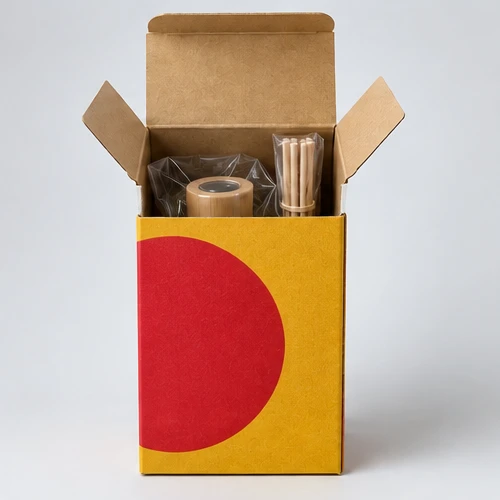
The MTT skincare duo carton shown here uses a lemon and lilac design, a tuck top and a specified pre-glued crash-lock base. Its product brief calls for uncoated kraft paperboard, opaque colour printing and a folded paperboard support. The bottle and tube occupy different positions; the support has to work with both shapes.
A material change therefore needs more than a matching colour swatch. Ask whether the new board folds cleanly at the existing creases, whether the base assembles squarely, and whether the support still holds each product without obstructing removal. Check the finished thickness before reusing the same dieline. The open view illustrates the layout; the bottom construction needs its own assembled-sample check.
For this design, approve the coloured surface on the proposed stock. A screen image cannot establish opacity or the appearance of a fold edge. Keep the material sample beside the artwork approval so the printer and structural supplier are working to the same revision.
03
Compare these fields before accepting a substitution
Material identity: mill or supplier grade, construction and the component it is used for.
Fibre declaration: the stated recycled content and supporting document, including the scope of the claim.
Physical specification: grammage, thickness and any agreed performance requirements, with methods and units.
Surface: colour, coating and the proposed print process; review a sample using the actual artwork.
Conversion: crease, fold, glue and closure behaviour in the assembled structure.
Approval: material revision, sample reference and which checks must be repeated after a change.
Do not substitute grammage for thickness. Virginia Tech’s basis-weight explanation defines it as mass per unit area. Its thickness guidance treats caliper as a separate measurement. Those pages concern corrugated board; for the skincare folding carton, request the applicable grade data and measurement method rather than copying a corrugated test setup.
04
Keep corrugated shipping decisions separate
A corrugated box combines liners with a fluted layer. A recycled-content requirement for one layer does not automatically describe the whole board or the finished pack. Ask the supplier to identify the layer combination and to explain any proposed replacement.
DS Smith describes differences between its kraft and recycled liner families and also identifies enhanced recycled grades. This is a reason to compare named grades and measured performance, not to assume every recycled board is unsuitable or every kraft board will pass. Changes to paper, flute, dimensions or glue can alter the complete box.
If your question is about an outer shipping carton, start with the corrugated specification guide and corrugated packaging options. Keep the retail carton and shipping carton on separate specification lines, with the packing arrangement linking them.
05
Run a controlled sample comparison
Give the supplier the current specification and the proposed alternative. Keep the products, artwork and packing sequence consistent so the comparison answers a clear question. If the dieline must change, record that change rather than attributing every difference to the paper.
Inspect printed surfaces and fold edges under the same viewing conditions.
Assemble the carton using the intended packing sequence, including the support and accessories.
Load the actual bottle and tube; check base closure, unwanted movement and removal access.
Record the material and drawing revisions, observed problems and agreed corrections.
Agree any additional handling or distribution validation needed for the intended route.
A hand-held sample review can answer fit and assembly questions. It does not establish a transport test result. Use the sample approval checklist to separate appearance, structure and any later validation.
06
Write a claim that matches the approved material
After selecting the material, retain the supporting declaration with the approved specification. Do not add a recycled percentage based on the photograph or use a fibre-content statement as evidence that every destination will recycle the assembled pack.
The existing recycled versus recyclable guide covers that claim distinction. This comparison addresses the earlier purchasing decision: which grade and assembled structure should be sampled. External technical sources were checked on 3 November 2026; final material percentages and performance remain specific to the selected supply and approved sample.
From guide to product
Compare packaging for your brief
Explore the opening, material and insert details for each design. These are options to review, not proof of a tested fit for your product.


 Bank Transfer
 PayPal