Packaging Boxes Without Plastic Lamination: What to Specify
Quick answer
To specify packaging boxes without plastic lamination, identify the surfaces covered by the requirement and request the complete alternative finish specification. Approve a decorated, assembled sample against agreed handling and appearance criteria. Removing a laminate does not automatically make the box plastic-free or recyclable: coatings, adhesives, inserts and accessories still need review. Keep the surface-performance decision separate from any environmental statement printed on the packaging.
Write the requirement so the supplier can price it
A request for packaging boxes without plastic lamination needs a defined boundary. Does it cover the exterior wrapping paper, the inner liner and insert, or every part of a gift set? Identify the surface and the film process you intend to remove.
Ask for the full proposed finish specification, including any coating, varnish, adhesive and decorative transfer. A matte appearance does not reveal whether a film is present. Likewise, water-based describes part of a formulation or process; it does not by itself establish that the finished construction is plastic-free or recyclable.
Use a precise purchasing instruction: quote the exterior wrap without an applied plastic laminate and identify all alternative surface treatments. Keep environmental copy out of the artwork until the selected construction has been reviewed.
02
Choose the surface around its real handling
List how the box will be handled before selecting a finish. Will it be packed directly into a shipping carton, displayed under retail lighting, repeatedly opened, or placed inside a paper bag? Which surfaces rub against the insert, lid, sleeve or neighbouring box?
Consider the following comparison as a starting point for discussion, not a universal performance ranking. An uncoated textured wrap may suit a tactile presentation, but its appearance should be checked after the intended handling. A printed wrap with a specified coating may offer a different feel and surface response.
The buyer's task is to approve an acceptable result, not to assume that every unlaminated surface behaves alike. Paper grade, colour coverage, decoration, adhesive and conversion all belong to the sample specification.
03
Look first at edges and contact points
Broad flat surfaces can look convincing in a photograph while vulnerable areas remain unexamined. Inspect wrapped corners, folded edges, the lid contact line and the area around a pull ribbon or finger opening. These are useful places to check for marking, cracking, lifting or visible colour change during the agreed handling review.
For a drawer box, examine the actual sliding fit rather than only a loose paper swatch. For a lift-off lid, repeat the intended opening action and inspect the contact surfaces. If the assembly binds, review dimensions and construction; a finish change should not be used to conceal a fit problem.
Record any defect with its location and conditions. “The surface marks” is too vague to guide a revision. A photo of the contact line, matched to the sample reference and handling sequence, gives the supplier a more useful starting point.
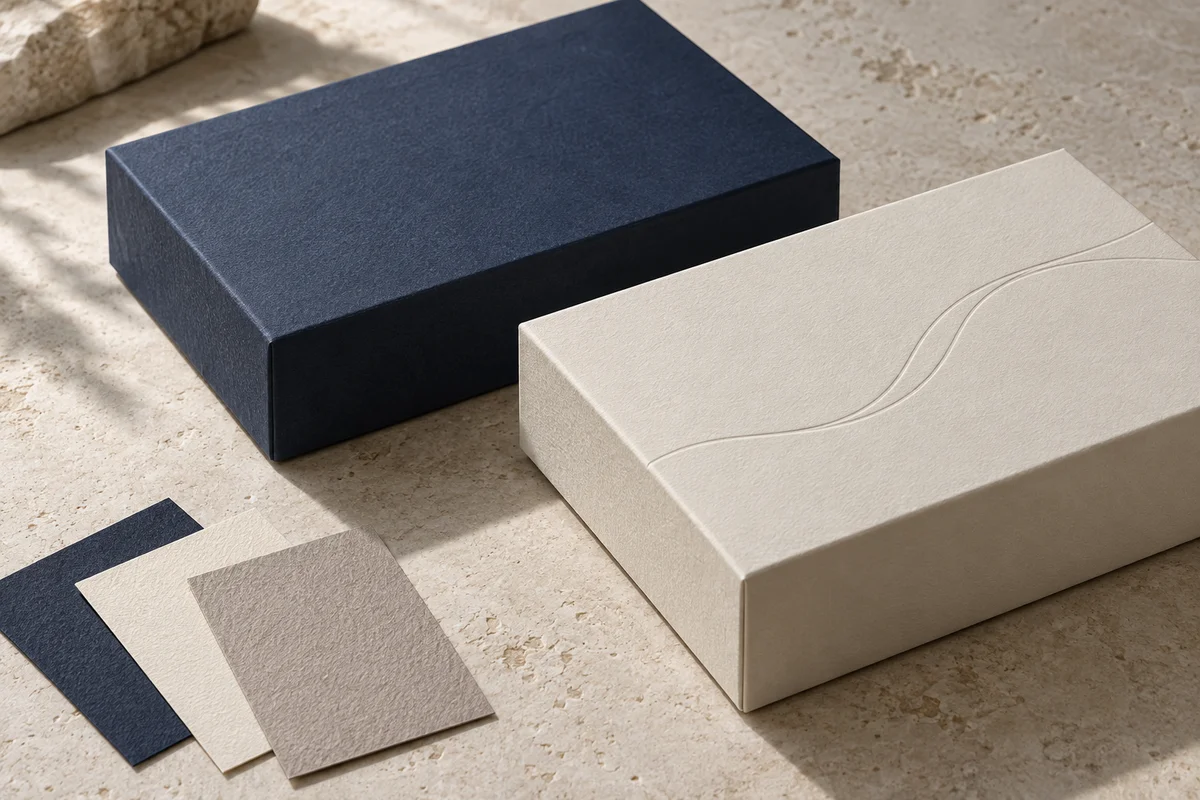
Illustration: navy and ivory paper-wrapped boxes with textured surfaces and edge details.
04
Make a finish acceptance brief
Agree the checks before judging competing samples. Include the intended product, box revision, surface treatment, lighting for visual review and conditions of handling. Specify which observations are unacceptable and which can be compared against an approved reference.
A practical review can examine appearance before and after representative rubbing, product removal and packing. Where damp handling is relevant, agree a suitable assessment with the supplier; do not improvise a liquid exposure and present it as a recognised test.
Keep the exercise bounded. A desk review can reveal a visible scuff or assembly issue, but it cannot prove transport performance or recyclability. Ask for separate evidence when either claim is part of the purchasing decision.
05
Review decoration as part of the new construction
If the design includes foil, embossing, debossing or printed solid areas, request those features on the candidate paper. An undecorated white mock-up cannot establish how the final dark printed lid will look after handling. Nor should a paper swatch stand in for wrapped corners and glued joints.
Discuss where decoration is necessary and where the material itself can carry the design. This is a design decision, not an automatic environmental improvement. Compare the appearance, manufacturing feasibility and evidence for the actual alternatives without declaring one process universally sustainable.
MTT's sample approval checklist connects these finish decisions to the complete box. Retain a representative approved sample with the material and artwork references so that a later paper or coating substitution triggers a deliberate review.
06
Check the environmental statement separately
Removing one laminate does not settle the recycling question for the complete packaging. The remaining wrap, board, adhesive, insert and accessories still need to be considered. Ask what the proposed statement covers and what evidence supports that scope in the destination market.
The 4evergreen design guideline offers a framework for discussing paper packaging and relevant recycling pathways. Use it to ask better questions about the selected construction, not as permission to print a recycling claim.
For US-facing marketing, the FTC Green Guides summary explains that environmental claims need appropriate support and qualification. Keep a narrowly described material change distinct from a broad environmental-benefit statement. Other markets require their own review. Do not replace “without plastic lamination” with “plastic-free packaging” unless the broader statement has actually been substantiated.
07
Release a specification rather than a finish nickname
The order file should identify the paper, treatment, decoration, adhesive where relevant, approved sample and acceptance criteria. If appearance depends on a particular grade, do not allow an unspecified equivalent to bypass approval. State how a proposed substitution will be evaluated.
Ask for the assembled dimensions and packing arrangement as well. A change intended to improve the surface may add a sleeve, tissue or other protective component. Assess that addition openly instead of treating the presentation box in isolation. Check whether the alternative still meets the original material objective.
The MTT sustainability overview sets out project-dependent material questions. That record is more reliable than approving the word matte or natural on its own.
From guide to product
Compare packaging for your brief
Explore the opening, material and insert details for each design. These are options to review, not proof of a tested fit for your product.



 Bank Transfer
 PayPal