Perfume Discovery Set Packaging: Vial Fit, Layout and Sample Approval
Quick answer
Design perfume discovery set packaging around the finished, labelled vials and the order in which customers remove and return them. Confirm capped dimensions, vial count and fragrance identification before choosing a shared box or insert. One outer box can serve several sets only if each internal layout controls movement and remains clear to pack. Approve a complete sample with actual components, then assess the shipping pack for the intended distribution route.
Plan perfume discovery set packaging around vial dimensions, removal access and fragrance identification. Compare shared boxes and approve a complete sample.
Start with the finished vial, not its nominal volume
A 2 ml or 5 ml description tells a buyer the fill volume. It does not specify the outside diameter, capped height, shoulder shape or label thickness needed to design a cavity. Two vials with the same stated capacity may need different supports. Ask for physical samples or controlled drawings of each finished component before freezing the insert.
Record the maximum outside envelope with the cap and label fitted, the filled weight, and any areas where contact could damage decoration. For cylindrical vials, check the label seam as well as the glass. Include representative dimensional variation from the vial supplier; a cavity that fits one hand-selected sample is not a production approval.
For detailed support-zone reasoning, see the perfume bottle insert design guide. The extra decision for a discovery set is whether every vial can be packed, identified and returned without disturbing its neighbours.
02
Choose a layout that customers can actually use
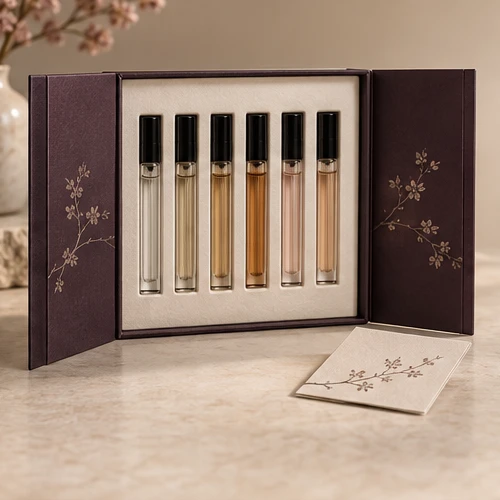
A horizontal row exposes the labels and makes a short set easy to scan. A two-row arrangement may make the outer box more compact, but the customer needs space to grip vials in the middle. Sketch the removal path before choosing the box footprint. A neat overhead rendering can conceal a cavity that only releases a vial when the whole tray is tipped.
We would compare a finger recess, a support that leaves a safe body area exposed, or a removable tray in the first structural sample. Avoid making the cap the only available grip point: depending on the closure, lifting there could separate the cap from the vial. Confirm the intended handling with the actual assembled component.
A scent card should remain readable while the set is open. If it lies over the vials, give it a defined removal step and confirm that its thickness does not press the closed lid onto the caps. Check the package both with the card present and after the customer removes it.
Six-vial double-door concept: compare access to the middle vials. Image illustrates a layout, not a tested fit. Explore this box structure.
03
When can several fragrance sets share one box?
Separate three decisions: a common outer box, a common insert and common printed identification. They do not have to be shared together.
Same vial geometry and count, different fragrances: a shared box and insert may be practical. Control the change through the scent card, sleeve or other approved identification, and keep packing instructions specific to each set.
Same vial geometry, different counts: compare separate inserts within one outer box. Empty visible cavities can make a smaller set appear incomplete. A covered compartment is an option to sample, not an automatic fix.
Different cap heights or body diameters: assess each fit separately. Do not enlarge every cavity to the largest vial and assume smaller vials remain secure.
Different retail and parcel formats: the presentation box may be shared, while the outer shipping pack needs a separate review.
A common box can reduce the number of outer specifications to manage, but it may add unused space, insert versions or packing checks. Compare the complete cost per finished set, including identification, assembly and shipping volume, before deciding that common tooling is economical.
04
Compare folding cartons and rigid discovery boxes
A folding carton with a folded paperboard insert is a candidate for a compact trial set where storage space and straightforward packing matter. Review how the insert is erected, whether small locking tabs remain accessible, and whether repeated vial removal weakens the support. Fedrigoni defines creasing as a preparatory operation for folding that helps avoid surface defects and cracking. That is a reason to review the converted sample, not only the flat artwork.
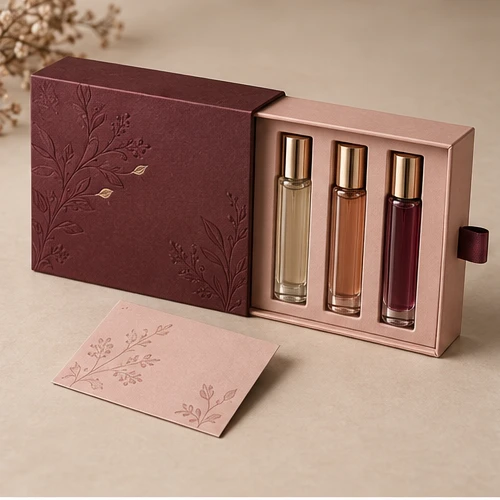
A drawer or lift-off rigid box may suit a keepsake or gifting brief. Check the drawer travel, access to the end vials and whether the tray remains stable when extended. A heavier outer box does not by itself establish better vial protection; the internal support and complete shipping configuration still matter.
Three-vial drawer concept: review tray travel, removal access and card placement on your sample. Explore the drawer format.
05
Prevent fragrance mix-ups during packing
Give each position a stable reference in the packing instruction: for example, positions 1–6 from left to right with the lid opening away from the packer. Match those positions to the approved scent names and product identifiers. A photograph of the open set is useful only if the orientation and artwork revision are unambiguous.
If customers are expected to return vials to the tray, put the identifying information where it remains visible after the vials have been removed. Colour can support the sequence, but should not be the only cue. Small labels and similar-looking liquids make a name or position reference useful.
Keep language versions, sample cards and sleeve artwork tied to the same set specification. At the packing trial, deliberately compare two similar variants and check how a packer distinguishes them. This is a proposed process check, not a claim about an MTT customer’s error rate.
06
An illustrative six-vial versus eight-vial decision
Suppose a brand is planning six-vial and eight-vial sets using the same vial supplier. This is an illustrative scenario, not a completed customer project. Start by laying out both counts with usable grip space. If the six-vial layout needs large concealed voids to occupy the eight-vial box, compare a smaller outer format before committing to one box.
If both layouts work within the same outer dimensions, quote a shared outer box with two clearly identified insert versions. Ask whether the total order quantity can be combined for the outer component and which costs remain separate for each insert and printed version. Do not assume the supplier’s minimum quantity applies to the combined set count.
Approve each configuration. An eight-vial sample cannot demonstrate that a six-vial insert has the correct retention, card fit or packing sequence. Keep a separate signed-off component list for each set even when the outside looks identical.
07
Approve fit, packing and transport as separate checks
Fit and access: load the finished vials, close the pack without forcing it, and remove and replace each vial. Inspect contact marks, label scuffing, unwanted movement and pressure on closures. Agree acceptable movement and cosmetic limits for this project rather than treating zero movement as a universal requirement.
Packing trial: assemble the insert, load the correct fragrances and card, and close the final packaging in the intended sequence. Record awkward steps, mix-up risks and any parts that need temporary manual support. Confirm that production materials and artwork revisions match the approved sample.
Distribution assessment: assess the complete shipper, not just the decorative box. ISTA’s design and testing guidance recommends understanding the actual distribution environment and using representative products and packaging. Choose the test plan with the relevant laboratory or distribution partner. This guide does not claim an ISTA test result or establish transport acceptance for a fragrance formulation.
Define what constitutes failure before testing: broken glass, leakage, displaced vials, unreadable labels or unacceptable box damage. Keep closure/leakage assessment distinct from tray fit. Use the sample approval process to document which configuration was checked and what still requires confirmation.
08
What to include in a discovery-set quotation brief
Vial supplier reference, capped dimensions, filled weight and labelled samples for every size.
Number of fragrances per set and the quantity of each set variant.
Preferred opening, vial orientation, removal method and whether the pack should be reusable.
Scent card, sleeve, language and artwork versions, including their packing sequence.
Preferred materials and finishes, plus any target budget for the complete packaging set.
Destination, distribution route, launch timing and the proposed sample approval process.
Request separate lines for the outer box, insert, printed card or sleeve, tooling, samples, packing and freight. Confirm which components can be shared across variants and which trigger separate setup costs. This makes a compact folding carton and a rigid presentation box comparable on the same scope.
From guide to product
Compare packaging for your brief
Explore the opening, material and insert details for each design. These are options to review, not proof of a tested fit for your product.
 Bank Transfer
 PayPal