Chocolate Gift Box Secondary Packaging: Buyer Checks
Quick answer
Chocolate gift box secondary packaging should be specified around the actual food pack: its wrapping, finished dimensions, storage requirements and handling route. A decorative box and divider organise the gift, but do not by themselves establish food-contact suitability, shelf life or temperature protection. Confirm which layers touch the chocolate, which enclose it and which protect it in transit before choosing paper, printing or insert details.
By Hugo He · Custom Packaging Consultant, MTT Packaging · Updated 2026-11-05
Packaging design reference. Final fit, materials and finish are confirmed on an approved sample.
At a glance
Specify chocolate gift box secondary packaging: contact layers, wrapped product sizes, dividers, storage and supplier documents before sampling.
Draw the packaging layers before choosing the finish
A beautiful box can still leave the most important purchase question unanswered: what separates the food from the decorated board? Start with a simple layer list. A loose paper cup, a sealed wrapper and a lidded tray are different constructions; do not describe them as interchangeable protection.
Layer
Purchasing question
Evidence needed
Food-facing cup, tray or wrapper
Does it contact the chocolate, and under what conditions?
Material identity and suitability evidence for the intended food and use
Gift-box insert or divider
Does it contact food, cups or sealed packs?
Drawing, actual contact arrangement and component specification
Decorated presentation box
What provides separation from inks, adhesives and board?
Finished construction and a review of the proposed use
Shipping pack
How are movement and the temperature route managed?
Complete packout and a route-specific validation plan
Calling a box secondary packaging is not enough to decide its regulatory scope. Have the responsible supplier assess the actual construction, including possible transfer through intervening layers. Keep the food-contact assessment attached to the specified materials and use conditions.
02
Use the MTT nine-position layout as a starting point
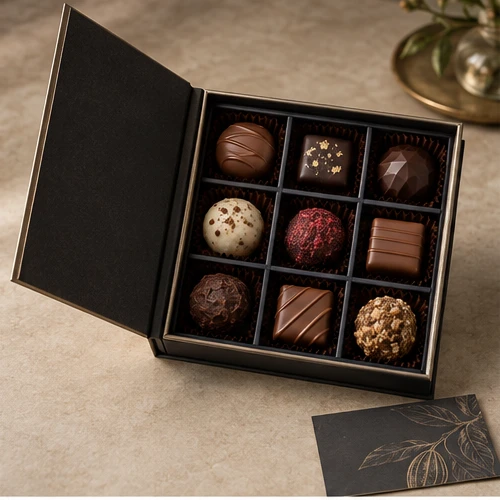
The MTT chocolate selection book box presents nine positions in a hinged format. The image shows chocolates in cups; it does not show individually sealed wrappers. Treat the pictured layout as a structure reference, then specify the food-facing components and protective pack required for your chocolates.
Measure the packed piece, including the cup rim, folded wrapper or tray flange. Ask which dimension varies most between pieces. A square chocolate with a flared cup may require a different clear opening from the chocolate itself. Check access for fingers or a removal method without forcing the adjacent piece out of position.
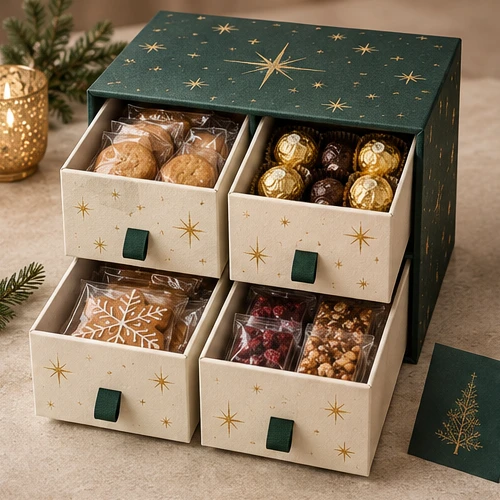
For a bar assortment, the chocolate tasting library is a different arrangement to discuss. Long channels and opening drawers need different retention checks from a nine-cell book box. Choose the layout around the product format, rather than treating every chocolate assortment as the same insert.
03
Separate clear cell size from the outside box size
The following is an illustrative divider calculation, not an MTT product specification. For three clear cells in a row, each 40 mm wide, with two internal dividers each 1 mm thick, the span is 122 mm: (3 × 40) + (2 × 1). That excludes the perimeter walls, insert-to-box fit and the presentation-box walls.
Illustrative layout input
Value
Included in 122 mm span?
Clear cell width
40 mm × 3 cells
Yes
Internal divider thickness
1 mm × 2 dividers
Yes
Perimeter walls or folded returns
Must be specified
No
Insert-to-box fitting space
Must be sampled
No
Outer rigid box walls and wrap
Must be specified
No
Check height separately with the actual chocolate and its cup or wrapper. The lid should close in the intended position without bearing on a delicate decoration. A divider layout drawing should identify clear cavities and wall thicknesses; the GSM and thickness guide explains why board weight alone cannot supply those dimensions.
04
Keep storage data attached to the chocolate type
Callebaut gives 12–18°C (54–64°F) as an ideal storage range for pure chocolate and a maximum relative humidity of 70% for chocolate products. It advises avoiding strong odours and light, and preventing condensation when colder products return to room temperature. See Callebaut: Confectionery Shelf Life — Good Storage Practices.
Use those figures as a discussion reference, not as a validated specification for every filled confection. The chocolate maker must establish the requirements for the actual recipe and shelf life. A rigid presentation box does not establish temperature control. Ask the fulfilment team to define the delivery route, expected exposure and whether a separate thermal shipping system is necessary.
Review packaging odour with the food business as well as appearance. A visual sample approval cannot establish the absence of taint or migration. Decide what evidence or testing is appropriate before releasing the material combination.
05
Request documents for the component and intended use
The European Commission explains that Regulation (EC) No 1935/2004 addresses food-contact material safety, including harmful transfer and unacceptable changes to food composition, taste or odour. Its guidance also describes manufacturing controls under Regulation (EC) No 2023/2006. Consult the Commission food-contact legislation overview for the applicable framework and material-specific rules.
For an EU-bound project, ask the responsible supplier which requirements apply to the proposed components and use. A generic food-grade statement is not a substitute for identifying the material, food type, contact conditions and relevant supporting evidence. Do not assume that one document covers every paper, coating, tray and adhesive in the set.
Request
What to match
Component and material identification
The cup, wrapper, tray, insert or box actually being supplied
Intended use
Food type, contact arrangement, duration and temperature
Supporting compliance evidence
Applicable market and material rules; document scope and limitations
Traceability and change control
Supplier, grade, batch or lot reference and revision
Sample approval record
Layout, packed product, finish and unresolved checks
Record who supplies the primary food pack and who approves the complete system. If a material or construction changes, review the affected evidence and sample again. This keeps the purchase brief usable when the project moves from artwork to production.
06
Make the sample answer the packing question
Pack representative pieces with the proposed food-facing components. Check whether all positions can be loaded without crushing cup rims, whether the lid closes without touching the contents and whether pieces remain in their intended locations during the agreed handling assessment. Decide the acceptance criteria with the chocolate maker; do not infer them from an empty display box.
Keep the presentation assessment separate from transport and food-safety approval. The packaging sampling process provides a place to record each decision, and the outer-carton guide covers the additional shipping layer. One complete packout reference is more useful than separate approvals that never meet in the same assembled sample.
From guide to product
Compare packaging for your brief
Explore the opening, material and insert details for each design. These are options to review, not proof of a tested fit for your product.

 Bank Transfer
 PayPal