Custom Paper Bags: Size, Handles and Loaded Sample Checks
Quick answer
Size a custom paper bag around the finished contents in their carrying orientation, including tissue and accessories. Specify width, side gusset and height with a drawing. Choose handles and reinforcement around the loaded weight and intended use, then evaluate an assembled, loaded sample. Paper weight and a premium handle finish do not establish a safe carrying capacity by themselves.
Use the external dimensions of the assembled box or the complete set that will enter the bag. Show its insertion orientation. For multiple items, document the arrangement rather than adding individual dimensions without accounting for their positions. Tissue, ribbons and protruding lids can change the clearance required.
Label width, gusset and height on the drawing. Ask whether the quoted dimensions are finished measurements and how they are checked. Leave handling clearance based on a physical trial; there is no single allowance that suits every stiff box, paper grade or presentation style. For coordinated fragrance sets, see box and bag planning.
02
Select handles by use and attachment
Handle choices to evaluate on a loaded sample
Handle option
Buyer consideration
Check at sampling
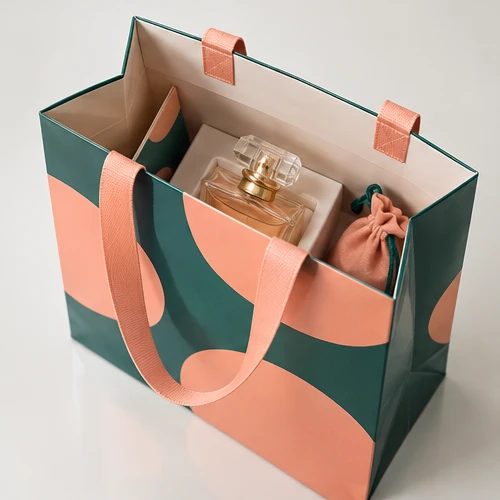
Ribbon
Visual coordination and feel in the hand
Attachment, slipping, edge discomfort and available hand clearance
Cord
Profile, grip and attachment detail
Knot or fastening retention, hole areas and reinforcement
Flat paper handle
Paper-based appearance and a different attachment area
Bonded area, peeling and carrying comfort under the intended load
Die-cut opening
No separate handle component
Opening shape, reinforcement and tearing around the grip
These options do not have fixed load capacities. The paper, reinforcement, attachment geometry, adhesive and contents all matter. Ask for the complete construction to be documented, including details hidden inside the folded top.
03
Review the base and top reinforcement
A flat-bottomed gift box and several loose bottles load a bag differently. Inspect how the contents sit on the base and whether a corner creates a local pressure point. Check the base fold, bonded areas and any base insert as a system. Reinforcing only the handles does not resolve a weak base.
Review the folded top and handle attachment from inside the bag as well as outside. A neat exterior can hide inconsistent bonding or an interfering handle knot. If a removable base board is proposed, include it in packing instructions and in every loaded evaluation.
04
Approve appearance alongside carrying behavior
A smooth bag paper can reproduce color and foil differently from a textured box wrap. Approve the set together using agreed physical references. Check where the folded edges, gussets and handle holes interrupt the artwork; keep essential information away from uncertain trim and fold boundaries.
Read matching foil across boxes and bags for coordinated finish approval. Scuffing and moisture exposure should be discussed for the expected use. Do not call a paper bag waterproof or assign an environmental claim simply because of its appearance or paper content.
05
Write a loaded-sample evaluation brief
List the complete contents and combined weight, including the presentation box and accessories.
Insert and remove the set without forcing the opening or catching decoration.
Check hand clearance and comfort with the intended handle length.
Agree carrying, lifting and hold conditions with the supplier, then document the observations.
Inspect the handle area, top fold, seams and base for changes after the agreed evaluation.
Record the exact paper, handles, reinforcement and adhesive construction of the approved sample.
Set acceptance conditions before evaluating samples. A single successful lift is only an observation under that condition, not a certified load rating. If the contents or construction change, review whether another sample evaluation is needed.
06
Specify packing and the next purchasing step
Paper bags can arrive flattened, with handles arranged in different ways. Confirm the packing method, quantity per shipping carton and protection against surface marking. Check whether the receiving team can store the bags and prepare them without damaging handles or creases.
A carrying bag does not replace a parcel shipping system. Use the corrugated transport-pack guide when the contents will be sent by courier. For a reorder, preserve the approved construction and sample reference instead of ordering only by size and color. This article provides a project checklist; it does not claim an MTT load test or a universal carrying limit.
From guide to product
Compare packaging for your brief
Explore the opening, material and insert details for each design. These are options to review, not proof of a tested fit for your product.


 Bank Transfer
 PayPal