Paper Bag Material Comparison for Perfume Retail Packs
Quick answer
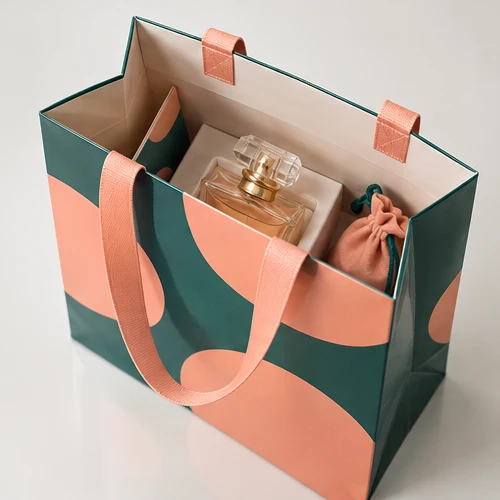
A paper bag material comparison should start with the filled retail pack, not a preferred paper weight. Compare kraft and coated paper for appearance, printing and conversion, then review the handle attachment and reinforced base together. The green and coral MTT perfume bag shown here uses ribbon handles and a coordinated printed exterior. The material specification still needs to match the actual box dimensions, loaded weight and carrying conditions.
By Hugo He · Custom Packaging Consultant, MTT Packaging · Updated 2026-10-31
Packaging design reference. Final fit, materials and finish are confirmed on an approved sample.
At a glance
Compare kraft and coated paper for a perfume shopping bag. Review print, handle reinforcement, the base and a loaded sample before selecting the material.
MTT-B0103: perfume retail bag with coordinated ribbon handles.
The pictured bag is a retail carry component. Its broad printed panels and ribbon handles connect it visually to the fragrance inside. It should be sized around the finished boxed product and its insertion orientation, including any pouch, card or tissue.
Distinguish a bag carried briefly from a shop from one expected to hold several heavy products during a longer event. Write down the intended use rather than asking for a universally “strong” paper. A shopping bag is also a different component from the outer carton used to ship the product.
Whether the selected shade and surface fit the brand artwork
Print the logo and important colours on that grade
Coated paper
Print detail, finish and fold appearance
Review the finished sheet after printing and conversion
Either option
Handle and base construction for the load
Carry the complete product arrangement using the agreed sample plan
Brown kraft can be an intentional part of the design, but its base colour becomes part of the print result. White kraft is a separate candidate, not merely a colour setting for brown paper. A coated candidate also needs a named grade and surface specification.
The pictured coral shapes and deep green areas are useful places to inspect consistency, folds and visible rubbing. Approve the actual printed bag beside the matching box. A screen image cannot settle the physical colour match.
03
Paper weight does not specify the complete bag
Grammage describes mass per unit area. It does not identify the fibre furnish, sheet thickness, direction-dependent properties, coating or converted bag construction. Keep the supplier’s named grade and relevant technical data with the sample.
Holmen’s technical information lists grammage, thickness and mechanical properties separately for paperboard. That distinction is useful when reading specifications, but its paperboard grades are not bag load ratings. Request data for the actual bag paper instead of copying a board specification into the order.
Use the GSM and thickness guide to distinguish those measurements. If a heavier candidate also changes the fold or handle area, assess the converted result. Increasing one number does not approve the finished bag.
04
Follow the load from the handle to the base
Start at the coral ribbon handles. Confirm the attachment method, how the top fold is reinforced and which area transfers the load into the bag wall. Pulling on an empty handle does not represent carrying the assembled fragrance set.
Then inspect the bottom fold and reinforcement. A rigid perfume box may concentrate load along its edges; confirm how it rests on the base and whether the corners catch during insertion. Review the seam and handle locations with the actual product arrangement.
Agree a loaded sample check covering the intended carrying movement and duration. Record the full weight, paper grade, handle specification and observed damage. There is no justified kilogram capacity to publish from these pictures alone.
05
Check finishing and assembly as a combination
The catalogue specification describes a coated shopping-bag paper with gloss lamination and colour printing. Review the assembled top fold, panel edges and bottom after finishing. Ask how the chosen coating or film affects the adhesive area and whether reinforcement changes the feel at the handle.
Where end-of-life requirements matter, specify the whole construction, including film, ribbon and reinforcement. Ask the intended collection or processing route how that combination is handled; the word “paper” alone does not establish recyclability.
06
Approve one complete bag specification
Keep the approved print reference, paper grade, finish, handle attachment, reinforcement and finished dimensions under one revision. Confirm whether tissue or a pouch is supplied with the bag or packed separately. Record the loaded sample used for approval.
When comparing quotations, ask each supplier to price the same construction. Otherwise a lower number may reflect a different finish or reinforcement arrangement. If a substitution is proposed, review the affected print, bond and loaded checks before accepting it.
The sampling guide explains how to keep the physical reference and written specification aligned. Choose the bag by the finished retail use, then retain the evidence for reorders.
From guide to product
Compare packaging for your brief
Explore the opening, material and insert details for each design. These are options to review, not proof of a tested fit for your product.


 Bank Transfer
 PayPal