In this guide · 6 sections
- Map the collection before choosing the box
- Compare ways to hold the tubes
- Size the row and check the sliding tray
- Approve the physical sample and shipping pack
- Ask for a comparable quote
- Sources
84 / Beauty Packaging
Quick answer
A lipstick set drawer box must let the customer slide open the tray and remove individual tubes without disturbing the rest. Start with closed products and their caps, then define the insert and tray clearance together. A physical sample is needed to check the loaded drawer.
 By Hugo He · Custom Packaging Consultant, MTT Packaging · Updated 2026-11-12
At a glance
Plan a drawer box for a lipstick collection: measure each tube, choose insert access, review the drawer and sample the full pack.
List each lipstick with its cap fitted, including labels, irregular bases and decorative features. Measure the maximum length, width and height rather than assuming all shades use identical containers. Note whether the customer should pick up tubes by the body or by an end.
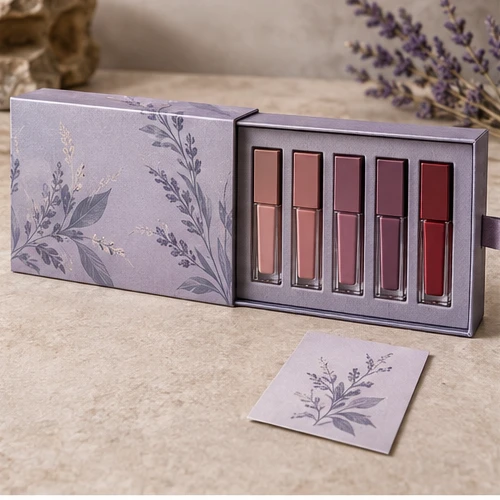
The lip colour wardrobe drawer-box design presents five slim positions in a sliding tray. It is a packaging design reference; the image does not establish an order, production tolerance or shipping performance.
| Option | Buyer decision | Sample check |
|---|---|---|
| Folded paperboard | Positions and a printed surface | Support below the tube and access to each end |
| Shaped insert | Support around an irregular package | Surface contact and force needed to remove it |
| Simple compartments | Separate individually boxed units | Cell fit and stability during tray movement |
Use the insert materials page to compare the choices. Friction, surface finish and material thickness all require review for the actual set.
Illustrative calculation: five positions each 25 mm wide with four 3 mm separating spaces occupy 137 mm (5 × 25 + 4 × 3). This excludes end margins, insert edges, material build-up and assembly clearance. The figures are a planning exercise, not a production specification or an MTT project measurement.
Review the inner tray height with the tallest capped tube, the sleeve clearance with the finished wrap, and any pull or finger notch. A tray that slides comfortably empty may behave differently when loaded. Review the drawer clearance guide for the sleeve-to-tray decision.
Load every position, slide the drawer open and closed, remove each tube and inspect the decoration for rubbing. Check whether any insert shifts as the tray moves and whether the pull remains accessible. Agree the sample type and record the final artwork, paper and insert revision before approving production.
Presentation and parcel protection are separate checks. FedEx describes individual cushioning and an outer protective box for fragile products; carrier requirements depend on the shipment.[1] ISTA explains that its procedures evaluate a specific packaged-product system, not a material in isolation.[2] No transit performance can be inferred from a rendering.
Provide the five product measurements if they differ, packed weight, artwork, desired opening sequence, order quantity and destination. Ask whether the box, insert, sample, tooling, packing and freight are separate line items. Compare suppliers on the same specification and quantities rather than the price alone.
From guide to product
Explore the opening, material and insert details for each design. These are options to review, not proof of a tested fit for your product.
Rigid gift boxes · Drawer box
Pearlescent wrapping paper
View structure & details →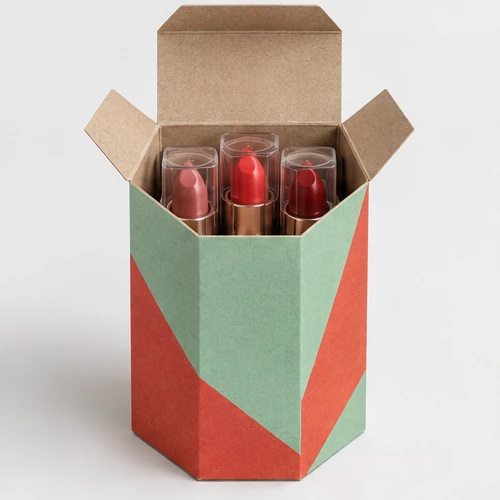
Folding cartons · Hexagonal tuck carton
Uncoated kraft paperboard
View structure & details →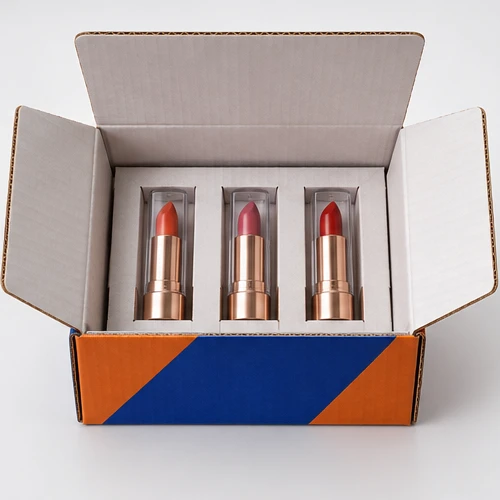
Corrugated packaging · Four-flap shipping carton
White-lined corrugated board
View structure & details →Payment Options
Available for confirmed production orders.
Available for eligible payments.
Available payment methods may depend on order value, project stage and transaction arrangements confirmed with MTT Packaging.
 Bank Transfer
 PayPal