Cosmetic Pump Bottle Packaging: Support, Clearance and Removal
Quick answer
For cosmetic pump bottle packaging, define the shipping state of the dispenser before sizing the insert. Review the filled bottle, locked or unlocked pump, overcap and any protective clip as one assembly. Support the intended bottle surfaces, keep the closure clear of unintended lid pressure and provide a usable removal path. Confirm the design with representative components and assess transport protection separately from presentation fit.
Plan a cosmetic gift box around the complete pump assembly. Review bottle support, lid clearance, removal access and the checks needed before approval.
Specify the dispenser state before drawing a cavity
A pump can have several relevant configurations: locked for shipment, released for use, fitted with an overcap, or protected by a separate clip. Ask the bottle and closure supplier which configuration is intended for your filled product. Record it on the packing instruction. A photograph of an unlocked display sample should not silently become the reference for a production pack that uses a locked head.
Measure the complete assembled envelope, including the projecting nozzle and any label seam. Record the filled weight and obtain dimensional variation information from the component supplier. If a cap is supplied separately, identify where it belongs in the set. Nominal fill volume alone does not determine the insert opening or the internal height of the gift box.
02
Separate bottle support from closure protection
We would first identify surfaces that can accept contact without compromising the container or its decoration. The body and base may offer candidate support zones, but their suitability depends on the actual bottle and finish. Do not assume that gripping the pump tightly is an acceptable way to restrain the bottle. Ask the closure supplier about load-sensitive areas and the function of any shipping lock.
A cavity should be reviewed for both the direction in which the product is loaded and the direction in which it might move. A shallow recess that looks tidy from above may leave an assembly free to tilt. Conversely, a deep recess may conceal the only safe gripping area. Compare support height, movement control and the user’s hand position on the same sample.
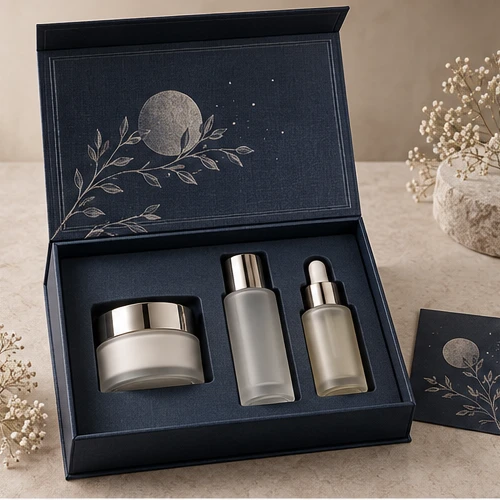
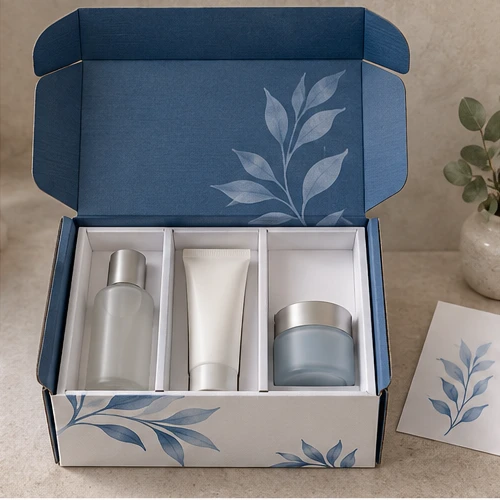
Existing AI-generated packaging concept: separate container positions illustrate layout planning. This image does not demonstrate pump restraint, clearance or a tested fit.
03
Check the lid against the complete set
Close the fully loaded sample with its cards, tissue and accessories in place. A box that closes when empty does not demonstrate clearance around the dispenser. Look for a lid that rises, a closure that requires force, or contact marks on the overcap. Investigate the cause before changing the insert depth; lowering one bottle may create a removal problem.
Do not specify a universal millimetre allowance from a product photograph. Agree the clearance with the packaging and component suppliers using the expected dimensional variation and construction. A book-style lid, a removable lid and a drawer have different paths around the product. Check that path, not only the final closed position. The insert options can help shortlist a construction; they do not provide a validated clearance for your bottle.
04
Use a decision record for the first sample
Observation
Question to investigate
Next evidence
Lid touches overcap
Is the assembled height or packing stack different from the drawing?
Loaded sample and controlled dimensions
Bottle tilts in cavity
Are support points and depth appropriate?
Revised structural sample
User can only grip pump
Can the body be accessed safely?
Removal trial with actual components
Leak after handling
Is the issue related to closure, filling, restraint or distribution?
Separate closure and packaged-product assessment
Keep observations separate from conclusions. A leaking sample is evidence of a problem, but it does not by itself identify the insert as the cause. Record the sample version, component state and handling sequence so that the relevant suppliers can investigate the same configuration.
05
Review packing and customer removal
Ask the intended packer to load the bottle without an improvised tool or an undocumented extra fold. Watch whether the nozzle catches the cavity edge, whether the lock must be disturbed and whether the bottle can be seated without forcing the closure. For a mixed skincare set, repeat the sequence with every component, including the last item to enter the tray.
Then review removal as a separate operation. A finger recess or accessible body area may help, but it must not introduce uncontrolled movement or expose a fragile surface. For an illustrative set containing a tall pump bottle and a short jar, a shared flat platform may leave the jar difficult to reach. Compare different support levels before making the entire box deeper. This is a planning scenario, not a customer case.
06
Treat leakage and distribution as separate approval questions
ISTA’s design guidance notes that orientation is not guaranteed in parcel delivery. Agree the distribution conditions and assessment with the responsible specialists; an upright retail display cannot establish performance through a parcel network. Define unacceptable leakage, movement and cosmetic damage before reviewing results.
A presentation insert is not evidence that the product formulation, closure or shipment satisfies any applicable transport requirements. Keep closure performance, product compatibility and outer shipping protection within the appropriate supplier or laboratory review. Document which checks were completed and which remain open.
07
Prepare a quotation and approval brief
Provide bottle and closure references, assembled drawings, representative filled samples, the specified pump state, finish-sensitive surfaces and all accessories. Add quantities by set and artwork version, the destination, packing location and the intended shipping route. Our sample approval guide explains how to separate structural and decoration decisions.
Request an itemized scope for box, insert, cards, sample work and shipping packaging. For a project starting at 1,000 pieces, send the complete pump-bottle packaging brief. Keep the final production release tied to the approved component combination rather than a single attractive photograph.
From guide to product
Compare packaging for your brief
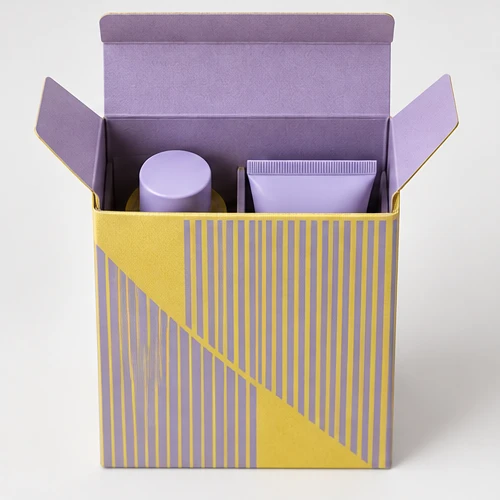
Explore the opening, material and insert details for each design. These are options to review, not proof of a tested fit for your product.
 Bank Transfer
 PayPal