In this guide · 6 sections
- Specify what the frame supports
- Review two doors, one product and the base together
- Plan removal without pulling on a fragile part
- Request an itemised solution
- Decision table: record the next action
- Sources
113 / Packaging Engineering
Quick answer
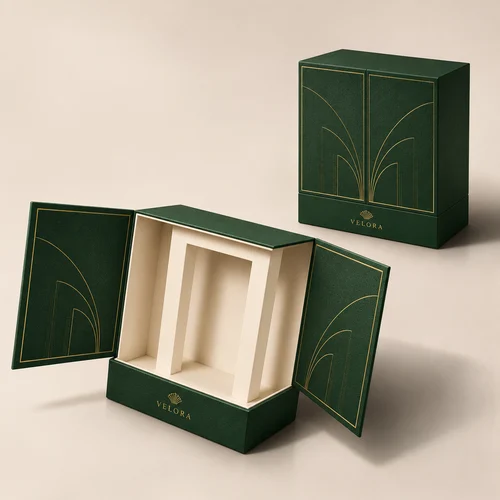
An upright frame can present a product between two opening doors, but a rectangular recess alone does not define how the item is held. Determine support points, removal direction and the path of both doors using the actual product and the proposed packing sequence.
 By Hugo He · Custom Packaging Consultant, MTT Packaging · Updated 2026-11-19
At a glance
An upright frame can present a product between two opening doors, but a rectangular recess alone does not define how the item is held. Determine support points, removal direction and the path of both doors using the actual product and the proposed packing sequence.
Imagine a gift set whose product looks centered in the artwork, but its cap projects beyond the frame and catches a door as it closes. The buyer needs a side section through the loaded assembly, not just a front elevation. This is an illustrative scenario, not a completed MTT case.
Measure the complete filled primary pack, including cap, decoration, protrusions and protective sleeve. Identify stable support surfaces and fragile surfaces that must not be compressed. State whether the item stands on its base, rests in a shaped insert or needs a separate retainer. Confirm the actual mechanism by sample; a rendered frame does not show its load capacity.
Draw the door travel and inspect the central meeting edge. Check that the supported product, any ribbon and the insert do not intersect the path when each door closes separately and when both close together. Confirm alignment and access without assuming that either magnets or a particular fastening are included.
The upright plinth and intended display position affect stability. Ask the supplier to review the filled unit on its intended surface and during the proposed packing operation; a display check is not a transport qualification. If the product sits high or is heavy, review the base and outer pack with the real load.
Decide where the recipient can grip the item and what is removed first. A finger recess, removable tray or retainer may be appropriate, but each changes presentation and tooling. Test the chosen solution with the actual primary pack, with any protective sleeve in place. Check contact marks and whether the support stays in position when the item is lifted.
Document the product orientation, support locations, open-door footprint, packing orientation and sample revision. If a second product size is added, recheck both door travel and support; the same external box can conceal a different interference.
Discuss the upright double-door concept, its frame and a separate shipping pack. FedEx lists different packaged-product distribution tests; select the relevant method and acceptance criteria with the responsible laboratory or carrier rather than claiming a render has passed.[1]
Send MTT finished product drawings or samples, filled weights, quantity per design, destination, intended retail or parcel route, and logo artwork. Custom concepts start at 1,000 pieces per design; the sample establishes feasible materials, structure and finish.
| Review point | What may go wrong | Next decision |
|---|---|---|
| Support | Product sits in frame but has no defined restraint | Identify base support and any retainer; review with actual filled product. |
| Doors | Door touches product or protective sleeve | Locate first contact; review product position and door path in section. |
| Removal | Only the cap can be gripped | Review finger access or a removable support, then recheck closed clearance. |
| Display and shipping | Box is stable on a table but the distribution route is unknown | Agree separate outer packaging and applicable testing scope. |
Use this as a discussion framework, not as a claim that the pictured concept has been manufactured or passed a test. Keep the actual sample, contents and revision together when comparing changes.
From guide to product
Explore the opening, material and insert details for each design. These are options to review, not proof of a tested fit for your product.
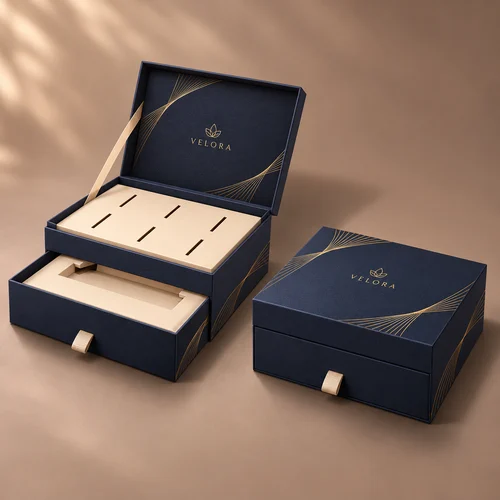
Rigid gift boxes · Hinged lid and lower drawer
Custom paper wrap; color confirmed by sample
View structure & details →Rigid gift boxes · Upright double-door rigid box
Custom paper wrap; color confirmed by sample
View structure & details →
Rigid gift boxes · Two-tier lift-off box
Pearlescent wrapping paper
View structure & details →Payment Options
Available for confirmed production orders.
Available for eligible payments.
Available payment methods may depend on order value, project stage and transaction arrangements confirmed with MTT Packaging.
 Bank Transfer
 PayPal