Skincare Gift Box Changes: When to Recheck Fit and Shipping
Quick answer
A change to the jar, serum bottle, insert or packing route can affect a previously approved skincare gift set. Compare the exact old and new configurations before reusing any fit or shipping evidence. The decision depends on what changed, the complete packed product and the agreed acceptance criteria; a visually similar component is not automatically equivalent.
By Hugo He · Custom Packaging Consultant, MTT Packaging · Updated 2026-11-16
Packaging design reference. Final fit, materials and finish are confirmed on an approved sample.
At a glance
Assess container, insert and shipping changes before reusing a skincare gift-box sample or transit test.
List each product and closure, the gift-box shell, wrap, insert, accessories, master carton and packing orientation. Identify the previous approved revision and the proposed revision. Note the product weight when filled, its sensitive finishes, and who assembles and ships the set. A supplier drawing or an approved sample is stronger evidence than a product photograph.
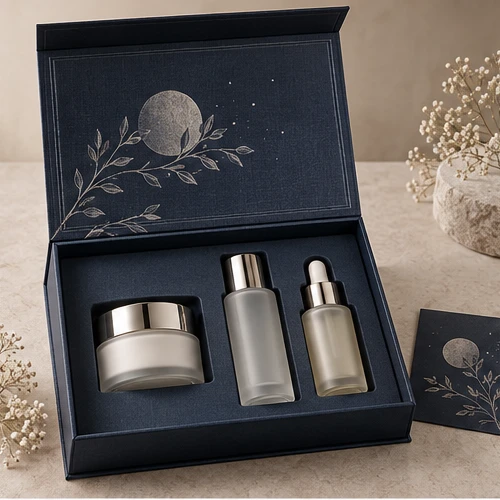
This guide addresses change control after an initial design has been evaluated. For designing the first insert, use the cream jar and serum insert guide. The pictured book-style box is a design reference, not a documented MTT test result.
02
Four changes that require an engineering review
Compare old and proposed packaged sets
Change
Possible effect
Check with the new revision
Taller dropper or pump
Closure may contact the lid before the box fully closes
Loaded lid clearance and normal closing
Wider jar lid
Opening can interfere while the body still fits
Largest permitted lid against smallest opening and removal access
New insert material or fold
Support, surface contact and assembly can change
Loaded fit, contact marks, assembly and removal
New outer carton or parcel route
The complete set experiences a different handling environment
Pack-out, orientation and an appropriate distribution evaluation
The table identifies possible effects for review, not universal test outcomes. Ask the product owner which marks, leaks, breakage or cosmetic changes are unacceptable before judging a sample.
03
Fit checks and transport tests answer different questions
A loaded appearance sample can show whether products fit, are accessible and permit the lid to close. It does not establish performance through a parcel or wholesale distribution network. Define the finished pack, the delivery route and the failure criteria with the party responsible for distribution; select an appropriate evaluation for that packaged product.
ISTA describes its procedures as tests of a specific packaged-product system, not certification of an individual material.[1] Its guidance also identifies product, packaging and process changes as factors in determining whether testing should be repeated.[2] Whether a particular change affects performance depends on the documented configuration and test requirements.
04
An illustrative change-control example
Example only: an approved set contains a cream jar and a capped serum bottle. A new marketing campaign keeps the box artwork but replaces the bottle cap with a taller dropper. The original insert drawing and box image do not establish clearance for the new closure. Measure the actual assembled bottle, review the tallest specified dimension, and close a revised loaded sample with the card and any protective layers in place.
If the new dropper changes the contact point or the loaded set, discuss the impact on the previous transport evaluation with the responsible test provider. This scenario is invented to show the decision process; it is not an MTT customer case or measured failure.
05
Keep the approval and quotation records separate
Record the drawing and component revisions, sample owner, fit observations and approved or rejected actions. Maintain any distribution-test report as its own record, with the tested configuration and route. A packaging quotation should separately identify shell, insert, tooling, samples, assembly and freight, along with quantities by design. An approved look does not by itself approve the changed product fit, delivery route or production schedule.
 Bank Transfer
 PayPal