A perfume and refill set puts two different containers in one presentation box. Start with the filled bottle and refill, including their caps, then plan separate support, clearance and a practical removal path for each. Approve the loaded box and complete shipping pack with representative products before confirming production.
By Hugo He · Custom Packaging Consultant, MTT Packaging · Updated 2026-11-11
Packaging design reference. Final fit, materials and finish are confirmed on an approved sample.
At a glance
Plan a lift-off gift box for a perfume bottle and refill: measure the contents, compare inserts, approve samples and calculate shipping volume.
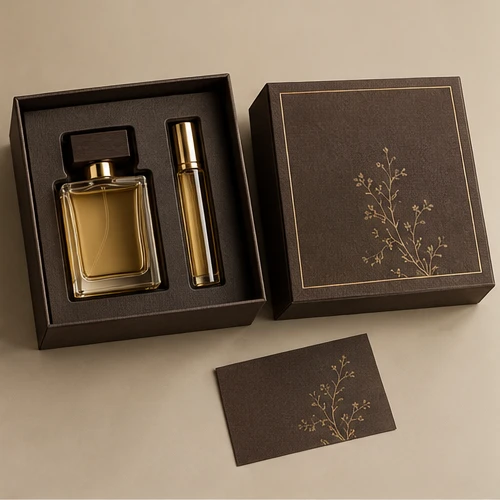
The MTT perfume and refill presentation illustrates a lift-off lid with two differently shaped positions. The image is a design reference, not evidence of a delivered order or transport test. For your brief, identify every item, cap, pump and protective cover. Send front and side photographs, drawings and filled weights where available.
Measure the largest width and depth of each item and its total height with the closure fitted. A nominal 50 ml bottle and 10 ml refill do not establish their outside dimensions: closures and shoulder shapes vary. Note whether labels, coatings or decorative parts must avoid rubbing or direct pressure. Keep product tolerances and the supplier’s drawing revision with the brief.
Open-set view: review contact points and removal access for both containers.
02
Plan two cavities and two removal paths
Choose whether both items are displayed at the same visual height or seated at different depths. An insert must locate each container without asking the cap or neck to carry unintended loads. A finger recess or suitable lift feature can make removal easier, but its placement needs a loaded sample: fingers must reach the refill without disturbing the main bottle.
Review the complete set before approving a sample
Check
Perfume bottle
Refill
Evidence to request
Fit and contact
Body, shoulder and cap clearance
Body and closure contact
Loaded insert with representative filled items
Removal
Grip without pulling the cap
Grip without lifting the bottle
Test the chosen finger recess or pull feature
Appearance
Label orientation and finish
Marking and surface contact
Inspect after agreed handling
Shipping
Both contents, lid, insert and outer carton
Agreed evaluation for the intended route
Compare material choices in the existing perfume insert buying guide. This article focuses on the two-container refill brief: separate cavities, independent access and the complete quotation.
03
Size the presentation box from the inside out
Use measured product sizes and the proposed insert construction, not a generic tolerance. For a simplified planning example only, suppose the bottle needs an 80 mm wide allocation and the refill needs 30 mm; a proposed 12 mm separation and 10 mm at each outer side gives 80 + 30 + 12 + 20 = 142 mm across the planned inside width. The allocations and gaps are illustrative, not approved cavity sizes or an outside box measurement. The insert walls, contact zones and fit still need engineering and sampling.
Depth, height and lid engagement must be assessed independently. A wrapped lid extends beyond the base, and paper, board, joints and operating clearance can affect the finished outside size. The inside versus outside dimensions guide explains what to request on a drawing.
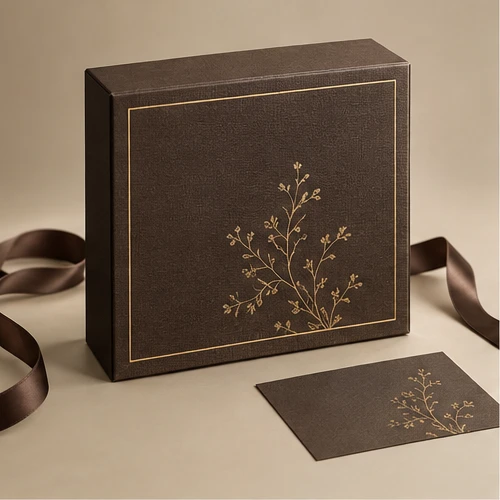
Closed-box view: check the finished external dimensions and lid fit on a physical sample.
04
Calculate freight volume using the complete carton
Measure the master carton after the full packing arrangement is defined. For an illustrative carton measuring 40 × 30 × 25 cm, volume is 40 × 30 × 25 ÷ 1,000,000 = 0.030 m³. If that carton actually holds 12 finished sets, 100 cartons would hold 1,200 sets and occupy 3.0 m³ before pallet space or other freight allowances. These figures are a calculation exercise, not an MTT shipment or freight quote.
Confirm carton dimensions, pieces per carton and gross weight on the approved packing plan. FedEx explains that dimensional weight depends on the shipping package’s measurements and can affect billable weight; its calculation and rounding rules are specific to the service and market.[1] Ask the chosen carrier for the current applicable terms. Do not reduce protective space solely to lower a volume estimate.
05
Approve the set, then compare like-for-like quotes
On a physical sample, check lid removal and replacement, both item positions, product access, surface contact and any printed information. Agree the finished shipping configuration and route-specific assessment separately. ISTA states that its procedures concern a specific packaged product rather than certifying an individual material.[2] No transport result can be inferred from the illustration.
Ask suppliers to itemise the box, insert, print and finishes, sampling, tooling, packing and freight basis. Specify the same quantities and delivery terms when comparing offers. Keep the approved drawing, material references and sample together; if a bottle, cap or insert changes, reopen the fit review. Use the sampling process guide for recording revisions.
06
Sources
FedEx: What is dimensional weight? Reviewed 11 November 2026. Carrier rules vary; the volume example above is illustrative and not a quotation.

 Bank Transfer
 PayPal