Necklace Packaging: Chain Management Without Awkward Removal
Quick answer
Necklace packaging needs a defined route for the chain, a suitable pendant position and a removal sequence the customer can follow. Specify the longest and shortest intended necklaces, clasp and pendant dimensions, and sensitive contact areas. Review how spare chain is managed behind or beneath the display. A tidy front view alone cannot demonstrate resistance to tangling or suitability for repeated use.
List the actual variants the box needs to hold. Record chain length, pendant dimensions and weight, clasp size, extension chain and any detachable parts. Include surface-sensitive finishes and the intended presentation position. Two necklaces with similar overall length can require different treatment if one has a large pendant and the other has several small elements.
Ask whether the customer should return the necklace to the box after use. A single-use packing arrangement and a reusable storage arrangement may demand different access. If the same outer box serves several collections, decide which insert or card versions remain separate. Do not enlarge every retaining feature to fit the largest clasp without checking the smaller items.
02
Map the chain route on both sides of the insert
Sketch where the chain crosses the display face, where it passes through the insert and where excess length rests. Each passage should have an intended function. Inspect edges and covered openings on a physical sample with the actual chain; a drawing cannot establish that a delicate link passes through without catching.
If excess chain is stored behind a display card, explain how the packer places it and how the customer releases it. A hidden bundle is not a chain-management method unless its position remains controlled and it can be accessed. Avoid relying on the customer to pull the pendant until the clasp finds its way through an unseen opening.
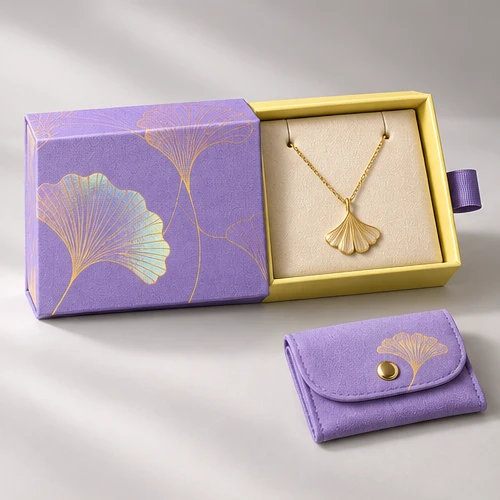
Existing AI-generated concept: the visible pendant arrangement is a starting point. Chain routing behind the insert and removal still require a physical sample.
03
Choose restraint that suits the finish
Compare candidate features such as a display card, covered slots, loops or a shaped recess. Assess where each feature touches the jewelry and how the user releases it. A softer-looking surface does not automatically establish compatibility with a coating or plated finish. Ask the jewelry and insert suppliers to agree the relevant contact checks.
Do not describe a lining as anti-tarnish, non-abrasive or suitable for long-term storage without evidence for the specified materials and intended conditions. This guide addresses mechanical arrangement and handling; it does not establish chemical compatibility. Keep any material treatment or storage claim separate in the specification and approval record.
04
Compare a display layout with a storage layout
Priority
Candidate approach
Tradeoff to check
Immediate pendant visibility
Front-facing card or insert
Access to chain and clasp behind it
Several chain lengths
Shared outer box with identified insert versions
Packing mistakes between versions
Repeated customer use
Accessible release and return sequence
Retention after repeated handling
Compact gifting format
Controlled excess-chain compartment
Available depth and removal access
For an illustrative short-chain and long-chain collection, start with both actual lengths. A longer chain may need a different route rather than a larger presentation box. If the pendant position changes between variants, review whether the artwork still aligns with the product. These are design decisions to test, not universal instructions for every necklace.
05
Run the packing and removal trial
Give a packer the proposed instructions and components, then observe the whole sequence. Record which way the insert faces, where the clasp goes, how spare chain is arranged and when the insert enters the box. Check whether the chain can be trapped between a drawer and its sleeve or between the insert and a closing edge.
Next, ask someone unfamiliar with the pack to remove the necklace using the intended method. Observe hesitation, hidden fastenings and any need to pull against resistance. Review how it is returned if reuse is part of the brief. Define the number of handling cycles and acceptable condition for the project rather than claiming indefinite durability.
Record observations against a labelled sample version. A useful approval photograph shows the front, reverse arrangement and packing sequence. For broader box choices, see the jewelry packaging options.
06
Keep the parcel assessment separate
A necklace can remain neatly displayed on a desk and behave differently within a shipping pack. Select an assessment that represents the intended distribution route. ISTA’s testing guidance emphasizes understanding the distribution environment when choosing a test. Agree unacceptable displacement, tangling and damage before evaluating the finished pack.
Inspect the complete arrangement after assessment, including hidden chain and clasp positions. Do not infer a cause from the front view alone. If packaging components change, review whether previous evidence still applies. A concept image or a product-page description is not a transport test result.
07
What a necklace-box brief should contain
Send necklace photos and measurements, chain-length range, clasp details, pendant weight where available, sensitive surfaces, required quantity and preferred opening. State whether a pouch, card or matching bag is part of the set and whether the box is intended for repeat use. Describe how goods will reach the customer.
For quantities starting at 1,000 pieces, request a necklace packaging review with those details. Compare quotations on the same outer box, insert, accessory and packing scope. The repeat-use jewelry-box analysis covers the wider opening and storage experience; keep chain routing as its own approval item.
From guide to product
Compare packaging for your brief
Explore the opening, material and insert details for each design. These are options to review, not proof of a tested fit for your product.
 Bank Transfer
 PayPal