Triangular Fold-Flat Cartons: Structure and Shipping Tradeoffs
Quick answer
A triangular carton can be considered for flat supply when its panels, end closures and assembly sequence work as one structure. Compare its final export packing with the erected alternative, including destination labour and protection. A folded photograph alone cannot prove that the blank assembles correctly or that the finished order will cost less to ship.
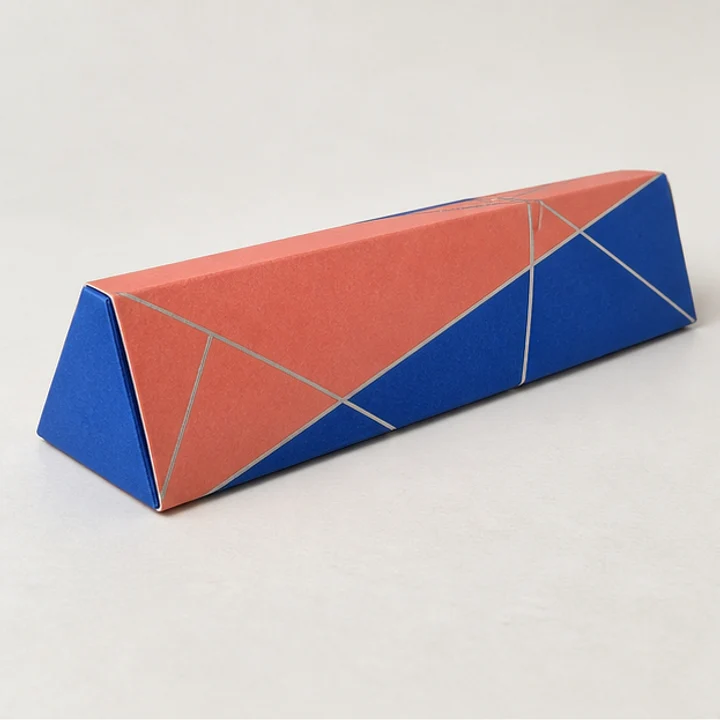
A triangular prism has two triangular ends and three lengthwise faces. It is different from a pyramid. Define the intended product orientation and usable cross-section first. The closed image is an appearance reference; it does not establish an approved flat drawing or end-lock design.
02
Every closure must connect to a real panel
Trace the fold sequence from the flat drawing. Identify the joining seam, end panels, closure tongues and any dust flaps. Check that parts meet without overlapping the product space or leaving a gap. We would reject a drawing that merely resembles the exterior but cannot close in the intended sequence.
03
Flat carton and collapsible rigid box are different routes
A creased folding carton and a wrapped collapsible rigid box need different allowances and assembly methods. Do not transfer a carton end flap to a rigid shell because both ship flat. Compare the folding carton options with collapsible rigid designs only after defining the required presentation and contents.
04
Prove packing efficiency with a carton plan
Alternating orientations may use space differently from stacking every triangle the same way. Include protective spacing, quantities per layer and gross weight. Compare flat blanks plus inserts with the complete erected alternative for the same order. The CBM calculation guide provides the volume formula, not a saving forecast.
05
What would make us retain an erected format?
Consider an erected option when packers cannot reliably form the angles, closures spring open or the finish marks during assembly. A repeatable packing trial matters more than a nominally thin shipping bundle. Record assembly steps, closure fit and loading access before approving decoration. This analysis makes no claim of a completed shipment or measured cost reduction.
From guide to product
Compare packaging for your brief
Explore the opening, material and insert details for each design. These are options to review, not proof of a tested fit for your product.



 Bank Transfer
 PayPal