E Flute vs B Flute: Choosing a Corrugated Box for Fragile Products
Quick answer
E flute is the finer, lower-profile option; B flute has a coarser, deeper profile. E flute is a useful candidate for compact printed packs, while B flute is worth comparing when a deeper board section suits the structure. Neither letter proves protection for fragile products. Choose using the specified board grade, fitted supports, finished box geometry and results from an agreed test of the complete packed product.
Packaging design reference. Final fit, materials and finish are confirmed on an approved sample.
At a glance
Compare E flute and B flute for fragile products: board grade, print, insert fit and tooling, plus the sample evidence to request before choosing a box.
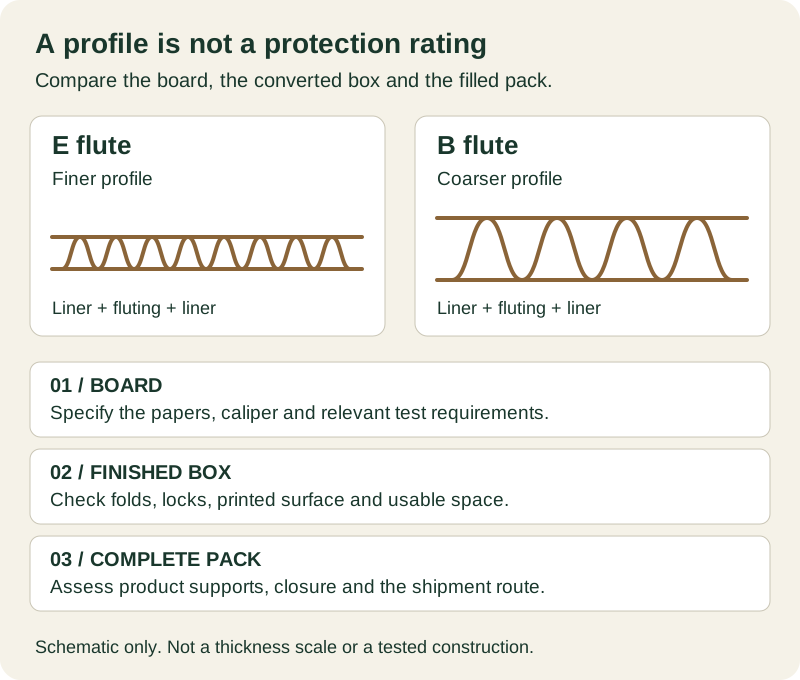
Single-wall corrugated board has a fluted paper medium between two flat liners, as shown in FEFCO’s board construction explanation. E and B identify different flute profiles within that construction. They do not specify the liner papers, medium grade, surface treatment or finished box strength.
Flute profiles are schematic. The drawing is not a thickness scale, strength ranking or approved construction.
02
Compare E and B around the same buying decision
E flute versus B flute: candidates and approval questions
Decision
E-flute candidate
B-flute candidate
Evidence to request
Compact presentation
Evaluate the finer profile for the proposed printed mailer.
Check whether the deeper section works at folds and exposed edges.
Finished, decorated sample with the intended contents.
Product and insert fit
Check usable space after all walls are folded.
Recalculate folded allowances if changing from E flute.
Revised drawing and loaded fit check, with dimensions labelled.
Fragile-product protection
Assess the complete support and closure system.
Assess the complete support and closure system.
Agreed packed-product test and recorded failure observations.
Repeat-order substitution
Retain the approved board and tool references.
Treat a switch from E as a specification change.
Converter review, new sample and approval of affected checks.
The same protection requirement appears in both columns deliberately: a flute choice cannot replace it. For the wider brief covering carton style, board construction and closure, use the corrugated mailer and shipping-box specification guide. This comparison addresses the narrower choice between two profiles.
03
For fragile contents, locate the failure before changing the board
If a glass item breaks inside a box that looks intact, first investigate how the product was supported. Could two items touch? Could a bottle rock out of its cavity? Was a thin neck, pump or decorated shoulder carrying load? A thicker outer wall alone may leave those contact paths unchanged.
Illustrative design review: two glass jars sit in separate corrugated compartments, but their lids can strike the closed mailer during movement. We would check vertical restraint, lid clearance and the support positions before proposing a change from E to B flute. If the new board reduces the available interior while the insert remains unchanged, the change could introduce interference instead of resolving the original problem. This is a hypothetical failure mechanism, not a reported MTT shipment.
If walls buckle or the closure opens, investigate the board, panel geometry, creases and closure alongside the insert. Record where the damage starts. The insert selection guide helps define support and removal requirements. Neither profile should be assigned a universal product-weight limit or assumed to cushion every fragile item.
04
A flute change needs a drawing and tooling review
Keep the product’s required usable space as a separate requirement from the flat cutting drawing. A roll-end mailer can have several board layers at its side walls and locks. Changing board caliper can affect those folded buildups, tab engagement and the insert opening. Simply cutting a thicker material with an existing die does not establish that the box will assemble correctly.
Ask the converter which score positions, slots, tabs and crease settings need review. The answer may be that a tool can be retained, adjusted or replaced; obtain that answer for the actual drawing and production route. Compare a fully assembled sample for forced folds, bowed panels, damaged liners and locks that disengage. These are inspection questions, not predictions that every B-flute conversion will fail.
Record internal dimensions, usable space with the insert installed and sealed external dimensions separately. If the usable interior must stay fixed, the outside dimensions may change. If the outside is fixed, available space may change. The packaging dimensions guide explains how to label and check those constraints. Recalculate shipping volume from the sealed sample rather than claiming a freight saving from the flute name.
05
Approve the printing route on the proposed board
Choose between direct printing on the liner and a separately printed sheet laminated to the corrugated construction as part of the brief. Do not compare an E-flute sample with one print process against a B-flute sample with another and attribute every appearance difference to the flute.
Use representative artwork containing the details that matter: small text, large solid areas, barcodes and graphics crossing folds. Inspect the proposed liner, visible flute pattern, print consistency and crease appearance on the assembled sample. If barcode readability is an acceptance requirement, request verification appropriate to the actual code and use.
Also ask whether the sample uses the intended production printing and converting processes. A digitally printed mock-up can show layout while leaving other appearance questions open. Identify those exceptions before approval. Compare quotes by board, print route, finish, tooling, insert and packing assumptions; neither E nor B is automatically the lower-cost finished solution.
06
Keep board evidence separate from complete-pack evidence
FEFCO lists distinct tests for board properties and corrugated packaging, including edgewise crush resistance for board and compression resistance for packaging. That separation matters when a quote supplies an edge crush test (ECT) value. It is evidence about the tested board property, not a result for the filled box’s resistance to every transit hazard.
Agree the relevant board requirements with the converter, including test method, units and conditioning where applicable. Then evaluate the complete proposed pack with representative products, inserts, closures and any outer protection. Matching one board value across E and B samples does not by itself make the two configurations equivalent.
ISTA distinguishes screening tests from simulations of transport hazards. Ask the testing provider to select the procedure and current edition for the distribution route and objective. Set product and appearance acceptance criteria before testing. Identify material changes or sample substitutions in the report, and review whether they require further evaluation. A result applies to the tested configuration and conditions; it does not guarantee every delivery.
07
Send one comparison brief and approve a defined configuration
Give the sample team the same requirements for both candidates. If one needs a revised insert or larger outer dimensions, document that difference. Compare complete workable designs while keeping clear which components changed; otherwise the trial cannot tell you what caused an improvement or failure.
Product: filled weights, maximum dimensions, fragile features, permitted contact areas and representative samples.
Journey: parcel or grouped shipment, repacking steps and known storage conditions.
Space: required usable interior and any fixed external-size constraint.
Board: proposed flute, liner and medium specifications, measured caliper and agreed property requirements.
Conversion: drawing revision, tool suitability, print route and any sample-to-production differences.
Acceptance: assembly, restraint, removal, appearance and agreed transport-test criteria, with findings for each candidate.
Retain the selected board reference, drawing, insert revision and physical sample with the approval. Use the sample approval process to close any open checks. Explore corrugated box options after the constraints are clear enough to compare structures.
Sources were checked on 16 October 2026. The selection framework and inspection questions are project-dependent engineering guidance; no customer test, damage reduction or MTT certification is claimed.
Is B flute always stronger than E flute?
No. The flute letter describes a profile, not a complete strength specification. Compare the liners, medium, relevant board test results and finished box design. Even matching board test values do not establish equal protection for a glass product in two different packed configurations.
Can an E-flute box be changed to B flute using the same cutting die?
Do not assume that it can. Have the converter check the die and crease design against the proposed board caliper. Recheck locks, folded walls, insert clearance and closed dimensions. Approve an assembled sample before deciding whether the existing tool can be reused or needs modification.
Which flute should I request for glass jars or bottles?
Request a proposed board grade and pack design around the filled product, its vulnerable areas and the shipping route. If both E and B constructions are practical, compare samples with equivalent support requirements and acceptance criteria. Bottle separation, restraint and clearance need approval alongside the outer box.
From guide to product
Compare packaging for your brief
Explore the opening, material and insert details for each design. These are options to review, not proof of a tested fit for your product.



 Bank Transfer
 PayPal