A useful approval record describes what was actually checked: the door edges, loaded insert, removal, appearance and complete closed assembly. It should also identify the sample revision and any remaining transport or production checks, rather than turning a visual approval into a performance claim.
By Hugo He · Custom Packaging Consultant, MTT Packaging · Updated 2026-11-19
Packaging design reference. Final fit, materials and finish are confirmed on an approved sample.
At a glance
A useful approval record describes what was actually checked: the door edges, loaded insert, removal, appearance and complete closed assembly. It should also identify the sample revision and any remaining transport or production checks, rather than turning a visual approval into a performance claim.
Imagine approving a print colour while the door-to-door gap has not yet been reviewed with the final insert. Those are different decisions. Use a short approval record that distinguishes the printed artwork, the assembled empty box and the filled sample. This is an illustrative example, not a project outcome.
Record the version of each part: left and right doors, wrap, plinth, frame, insert and primary product. List the colours and finishes as sample references; a digital image cannot establish exact colour or foil appearance.
02
Check movement and contact in a consistent order
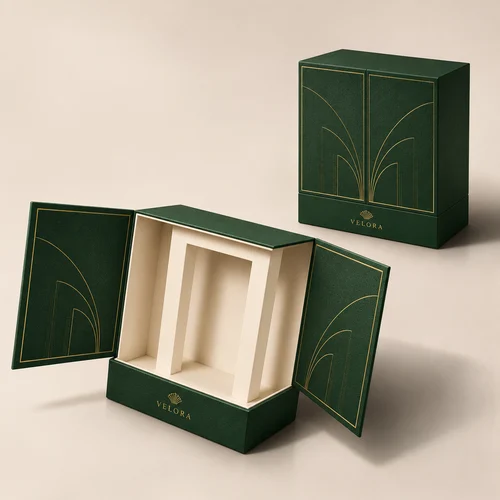
Place the box in its intended position, open each door and inspect the hinge area and meeting edge. Load the final representative product and insert, then close each door and both together. Look for a protruding product, interference, uneven contact and any abrasion observed during normal operation.
If a door catches, identify the first point of contact before requesting a larger box. A shifted insert, excess product projection, folded tissue or alignment may be responsible. Note the actual finding and revise the relevant component. Do not set a universal door gap or force from a photograph.
03
Review product access and handoff
Ask a person unfamiliar with the sample to find where to grip the product. Check that the supporting frame remains stable and that removal does not pull on a cap or decorated edge. Record the intended packing order and how doors are protected until the recipient opens the box.
For a filled sample moving through a carrier network, define the outer carton, cushioning, route and acceptance criteria separately. FedEx lists distribution and material tests; selection and results require a specific documented test with the agreed pack.[1] A display sample is not evidence of passing such a test.
04
Issue a controlled approval and quote request
List accepted characteristics, deviations, photographs, product versions and unresolved checks. Request an updated sample when a material, position or closure change may affect function. Agree the point at which the artwork and construction are frozen.
Share your brief against the double-door frame concept. MTT can coordinate a custom sample and quotation from 1,000 pieces per design; dimensions, logo, colours and finishes are project-specific.
05
Decision table: record the next action
Buyer decision record
Review point
What may go wrong
Next decision
Visual review
Colour or logo approved from a screen
Compare the physical printed and finished sample under agreed viewing conditions.
Door path
Door catches only after the set is loaded
Identify product, insert or accessory contact before changing the shell.
Product access
Recipient grips a delicate cap
Review the support and removal path using the real primary pack.
Transport
Presentation box approved without its carrier pack
Define the outer packaging and any relevant test as a separate decision.
Use this as a discussion framework, not as a claim that the pictured concept has been manufactured or passed a test. Keep the actual sample, contents and revision together when comparing changes.

 Bank Transfer
 PayPal