Two Candle Jars in a Drawer Gift Box: Fit, Weight and Separation
Quick answer
Begin with the filled, capped jars, not a nominal capacity. Compare the largest body, lid and label envelope for every scent, and weigh each finished component. Record whether lid edges, decorated glass or labels may contact an insert. A heavier variant can alter the drawer load even when the outside diameter is unchanged.
By Hugo He · Custom Packaging Consultant, MTT Packaging · Updated 2026-11-22
Packaging design reference. Final fit, materials and finish are confirmed on an approved sample.
At a glance
Compare filled candle jars, lid clearances and insert supports before specifying a two-jar drawer box with a separate accessory channel.
Begin with the filled, capped jars, not a nominal capacity. Compare the largest body, lid and label envelope for every scent, and weigh each finished component. Record whether lid edges, decorated glass or labels may contact an insert. A heavier variant can alter the drawer load even when the outside diameter is unchanged.
02
Locate both jars and protect the gap
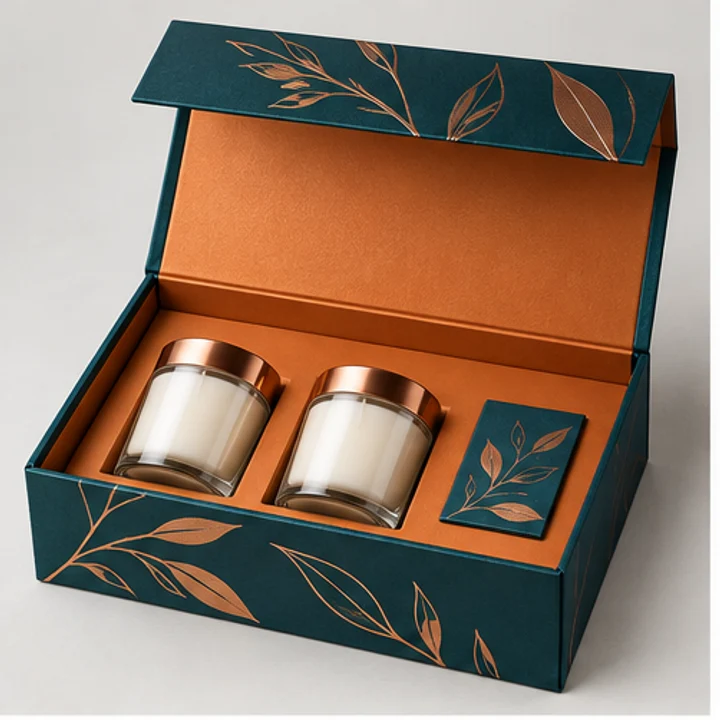
Lay out the pair in the actual packing orientation. Check the wall between cavities as well as clearance at the outer tray edges. The material must retain the jars during the intended handling while leaving enough access to remove either one independently. A tray with impressive top presentation may conceal insufficient base support, so review a section drawing and the assembled sample together.
03
Inspect the loaded drawer travel
With both jars and the accessory in place, open and close the drawer throughout its travel. Check if the tray sags, catches the sleeve or shifts as the loaded end passes the sleeve edge. Inspect the pull attachment and the base of the tray; do not infer a load rating from ribbon appearance. Establish who carries out any agreed load or transit test and record acceptance conditions before sampling.
04
Illustrative size variation
If a seasonal candle uses a taller lid but the same glass jar, place that complete variant in the approved tray. Compare the highest point with the sleeve interior and observe the label and lid during repeated opening. If contact appears, decide whether to alter support height, sleeve clearance or the set layout, then document the revision and repeat the relevant review.
05
Give the supplier a complete scope
Send jar dimensions and filled weight for each scent, intended carrying and shipping route, quantities by artwork, and a note on label-sensitive areas. Ask for shell, insert, optional tool, sample, tooling and freight to be quoted separately. A presentation drawer is not, by itself, a validated shipping pack. See ISTA test selection guidance: ISTA test selection guidance. Orders start at 1,000 pieces per design and US$2,000 product value per order; freight, samples and other fees are excluded.
06
Compare the insert approaches
A folded board cradle can separate two regular shapes with walls and locating folds. A shaped insert may reproduce more of a jar profile. Both need review where the base carries weight, at the rim and around the label. Ask for the same jar orientation, finger access and available height when comparing samples; material alone does not establish protection.
07
Plan the retail and shipping handoff
A retailer may carry the drawer by its sleeve; a warehouse may pack it flat in a larger shipping carton. Tell the supplier which orientation and handling are expected, and do not assume the presentation sleeve is the transport closure. Agree the actual outer pack, any protective wrap and the acceptance conditions with the logistics team. A generic sample drop cannot establish performance for every route.


 Bank Transfer
 PayPal