In this guide · 6 sections
- Orient the actual vials
- Reserve room for the card stack
- Check drawer movement and removal
- Keep names matched during pack-out
- Approve the complete package
- Sources
101 / Fragrance Discovery
Quick answer
A drawer may hold four sample vials neatly and still jam once cards are added. Measure the finished capped vials and the entire card stack, then check their positions against the sleeve, tray walls and pull. Review the packed sample before approving artwork.
 By Hugo He · Custom Packaging Consultant, MTT Packaging · Updated 2026-11-17
At a glance
Plan vial channels, card thickness and drawer travel together before approving a fragrance discovery set.
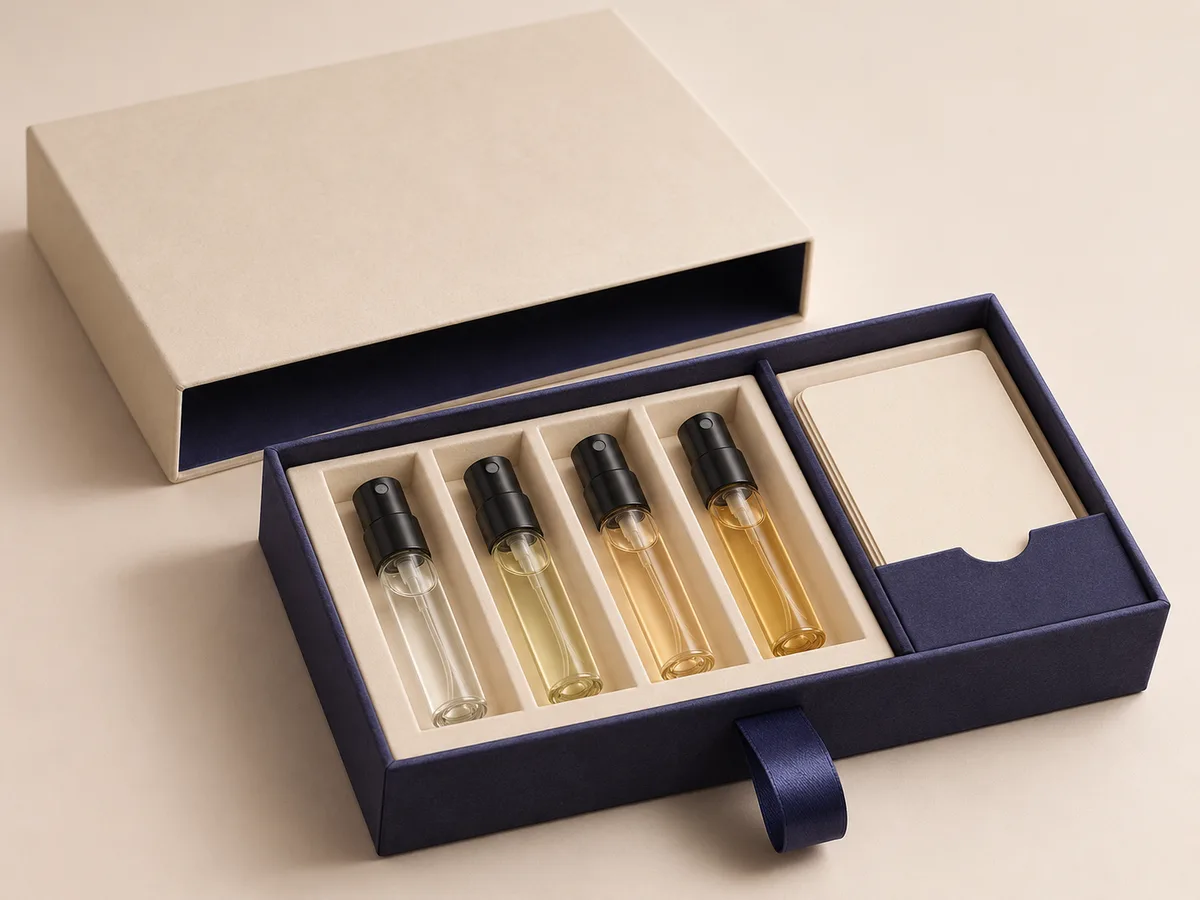
Measure every filled vial with its sprayer and cap fitted. Record maximum diameter or width, overall length, label position and any surface that should not rub. If fragrances use different vial suppliers, compare their specified dimensional ranges. Do not size a channel from nominal liquid volume.
Record the order of the four scents and the direction of each label on the insert drawing. Where caps, spray heads or label seams differ between variants, the packing team should use the most relevant representative combinations rather than assuming all four positions behave identically.
Measure the full card stack rather than one sheet: include folds, sleeves and any separator. A pocket with a thumb recess lets the recipient remove cards without levering against a vial. If the cards project above the tray or catch inside the sleeve, change the pocket depth or placement and retest with the final stack.
Try the empty drawer first, then the insert, vials and cards in sequence. Observe when resistance appears. Check that the ribbon pull is fixed to the tray without obstructing travel, and that users can lift each vial by a suitable surface rather than the sprayer. Compare with the general drawer clearance guide.
Illustrative review: a pocket fits five flat cards but jams with a folded instruction leaflet. Try the approved stack, then look for contact marks on both pocket and sleeve. If a pocket must be deepened, confirm that the change does not reduce the support below the nearby vial channels. This is an engineering example, not a reported customer outcome.
Agree a position map linking each scent, vial label and card version. If the same outer sleeve is used for different assortments, define a clear version identifier and a check at packing. The scent identification checklist addresses that separate control.
Request samples with the proposed wrap, board, insert, actual capped vials and card stack. The four-vial drawer concept is illustrative; material and fit need confirmation. If shipping is planned, agree the complete outer pack and testing needs with the appropriate laboratory. ISTA describes tests as applying to a specific packaged product, not an individual material.[1] MTT reviews orders from 1,000 boxes per design.
From guide to product
Explore the opening, material and insert details for each design. These are options to review, not proof of a tested fit for your product.
Rigid gift boxes · Drawer box
Wrapping paper; color and texture confirmed during sampling
View structure & details →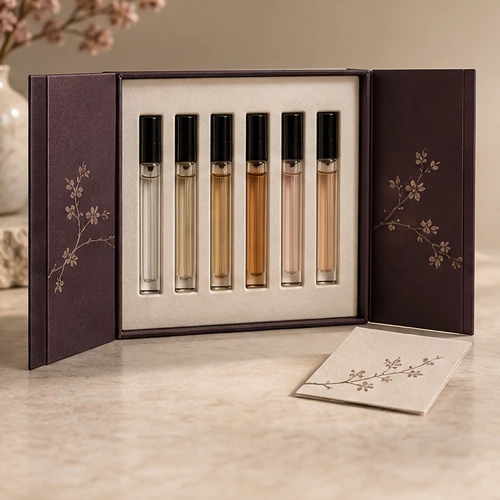
Rigid gift boxes · Double-door box
Pearlescent wrapping paper
View structure & details →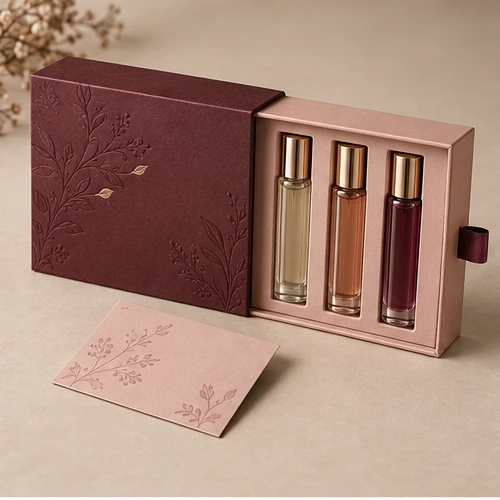
Rigid gift boxes · Drawer box
Smooth matte printed wrapping paper
View structure & details →Payment Options
Available for confirmed production orders.
Available for eligible payments.
Available payment methods may depend on order value, project stage and transaction arrangements confirmed with MTT Packaging.
 Bank Transfer
 PayPal