Apparel Gift Box and Paper Bag Sets: Fit, Folding and Brand Consistency
Quick answer
Size an apparel gift box around the folded garment plus tissue or belly band under light compression, then size the matching paper bag around the finished outer box rather than the garment. Confirm whether the box sits flat on the bag base or stands upright, check gusset and handle clearance with a loaded sample, and compare colours and foil on the actual wrapping paper and bag stock together before approving production.
By Hugo He · Custom Packaging Consultant, MTT Packaging · Updated 2026-11-25
Packaging design reference. Final fit, materials and finish are confirmed on an approved sample.
At a glance
Plan an apparel gift box and matching paper bag: measure folded garment bulk, size bag gussets around the finished box, and approve colour and foil together.
Unlike glass bottles or metal tins, folded shirts, knitwear, socks and silk scarves settle and spring back after folding. Measuring a garment loosely on a table often creates a box that either bulges at the lid or leaves excessive slack once the parcel settles in transit. Fold the actual item with its tissue paper, collar insert, hangtag or belly band as it will be packed, apply gentle hand pressure to reflect closed-lid contact, and record the finished length, width and height across the thickest fold or button placket.
If a single box size will serve multiple sizes—such as S through XL—measure the largest and thickest variant in the range rather than the sample size alone. Use the box size calculator to estimate starting box tolerances, then confirm the closure feel with physical garments in a structural sample.
02
Match box structure to garment weight and flat-pack shipping
Apparel gift sets often have a large footprint relative to their weight, which makes empty-box freight a major landed-cost driver. Compare structures around both presentation and logistics rather than choosing a rigid box by habit:
Box format
Garment fit strengths
Bag pairing implications
Freight and sample checks
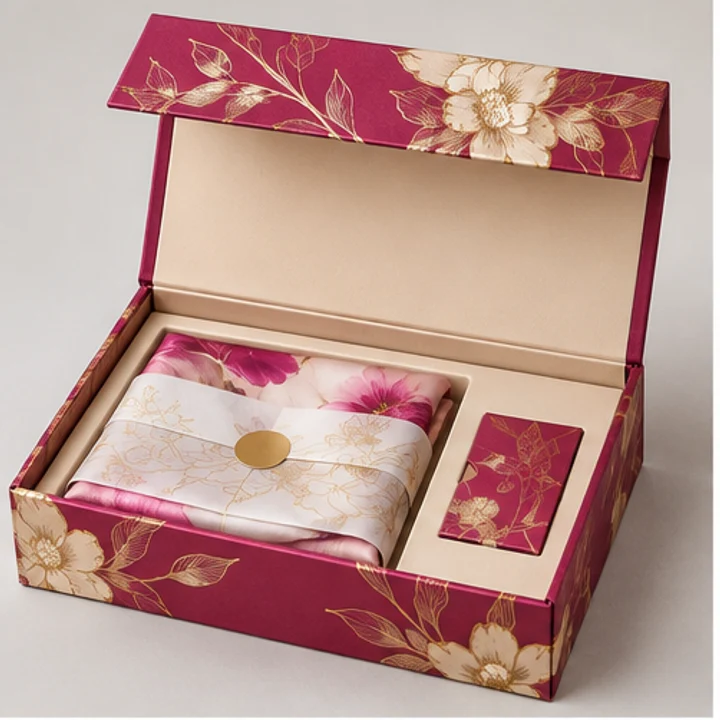
Collapsible magnetic rigid box
Wide presentation reveal; ships flat before store or warehouse assembly
Uniform rectangular walls slide smoothly into wide-gusset or upright bags
Check corner fixing, fold-line wear and magnetic flap strength when garment presses upward
Two-piece lift-off rigid box
Clean rim, no folding crease on display faces, strong corner rigidity
Slightly wider lid overhang increases external footprint entering the bag
Confirm lid friction does not trap tissue or pull the base upward when packed
Folding carton (pillow or tuck)
Compact and lightweight for scarves, socks or single retail items
Fits slimmer bags; curved pillow cartons may need an angled or flat base insert
Verify board caliper and crease cracking across folded garment bulk
Size the matching paper bag around the finished outer box
Do not size a retail bag from internal box dimensions or garment size. Measure the assembled external box—including lid overhang, magnetic flap thickness and any outer ribbon—and decide whether the customer or store staff will insert the box flat on the bag base or upright on its edge.
Illustrative box-and-bag measurement guide. Exact clearance depends on paper stiffness, gusset fold crispness and handle hardware, and must be checked on an assembled sample.
For flat-base carry, a wide gusset allows the box to sit horizontally without tipping, but a broad base span requires a stiff cardboard bottom insert so the bag does not bow under heavier knitwear or multi-piece sets. For upright carry, keep enough height between the top of the box and the bag's top turn-over so internal rope knots, grommets or ribbon anchors do not scratch the box corners during loading. Review paper bag dimensions, handles and load checks and box-and-bag coordination principles when setting tolerances.
04
Choose handle style and bag board around real carry behaviour
Apparel sets range from lightweight silk scarves and socks to heavy boxed coats or multi-garment gift sets. Choose handle attachment and reinforcement around how the bag is carried in store and on the street:
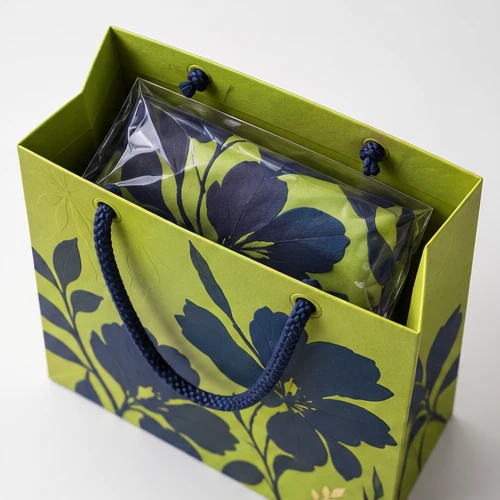
Braided cord or ribbon handles with top turn-over — Suited to boutique gifting where clean presentation and comfortable hand feel matter; confirm knot or glue-tab security inside the top reinforcement card, as seen on the cord-handle scarf bag concept.
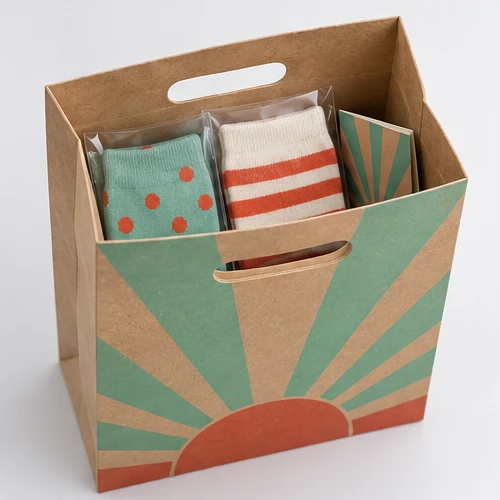
Die-cut handle bags — Eliminate separate cords and pack flat cleanly for lighter accessories such as socks or compact cartons; check wrist space and top-edge reinforcement on the die-cut handle gift bag concept.
Twisted or flat paper handles — Useful when an all-paper handle construction is preferred; verify patch adhesion and base fold strength with the loaded box inside.
Approve colour, lamination and foil across both substrates together
A rigid apparel box and a shopping bag rarely share the exact same paper construction. The box is typically wrapped in thinner coated, dyed or satin-finish paper over greyboard, while the bag is printed directly onto heavier shopping-bag board. Even with identical Pantone or CMYK artwork, surface absorbency, coating, matte vs gloss lamination, and paper shade shift the final appearance.
As KURZ's hot-stamping guidance explains, foil transfer relies on coordinated heat and pressure and behaves differently across smooth coated and textured fibrous surfaces. Fine serif logos or thin borders that stamp crisply on a smooth laminated box lid may fill in or break up on a textured uncoated bag unless die pressure and line weights are reviewed on the actual stock. Place the finished box and bag samples side by side under retail lighting, and read our box-and-bag foil matching guide for the sign-off checklist.
06
What to send for an apparel box and bag sample review
To review structure, bag sizing and material consistency in one quotation cycle, include:
Folded garment dimensions (L × W × H under light hand compression) and weight for the largest SKU
Whether tissue paper, hangtags, spare buttons or cards sit inside the box
Preferred box opening (collapsible magnetic, lift-off lid or folding carton) and shipping plan (flat-pack vs assembled)
Intended bag orientation (flat-base vs upright), preferred handle type and carry load expectations
Artwork files with separate spot/foil layers, quantity per size (minimum 1,000 pieces per design), destination and target delivery window
Should an apparel gift box lie flat or stand upright inside a matching paper bag?
Either orientation can work, but each drives different bag dimensions and base support. Lying flat keeps the garment stable and reduces tip risk, while demanding a wider side gusset and stiffer bottom card; standing upright uses a narrower gusset, while placing the box top closer to the handle turn and knot clearance.
Can I approve one artwork PDF for both the apparel box and the shopping bag?
No. Rigid box wrapping paper is laminated onto greyboard, whereas a shopping bag is printed and creased directly on thicker bag board. Confirm Pantone or CMYK colour, lamination and hot foil on physical samples of both substrates side by side under consistent lighting.
From guide to product
Compare packaging for your brief
Explore the opening, material and insert details for each design. These are options to review, not proof of a tested fit for your product.

 Bank Transfer
 PayPal