In this guide · 4 sections
- Keep geometry and loading on separate lines
- Use a surrogate for a limited question
- Ask what would change the quote
- Define the release point
119 / Cosmetic packaging procurement
Quick answer
An empty jar can establish an outline, but it cannot show how far a loaded insert will deflect. Ask for a provisional quotation using documented dimensions and an explicit mass assumption. Reserve structural approval until the supplier can review the filled retail units in the proposed presentation and shipping packs.
 By Hugo He · Custom Packaging Consultant, MTT Packaging · Updated 2026-11-20
At a glance
An empty jar can establish an outline, but it cannot show how far a loaded insert will deflect.
Use the empty container to locate the body, cap and decoration. List the expected gross mass of each filled, closed SKU separately. A nominal volume is insufficient to calculate gross mass without the fill density and the container mass. A buyer with finished stock can weigh one complete unit and identify exactly which revision was weighed.
For an early layout discussion, identify a dummy as a dummy. Matching total weight at the bottom of a bottle can hide a tendency to tilt if the real mass sits higher. Keep unknowns on the sample label. Use the actual primary pack before accepting support, surface contact or customer removal.
Ask the supplier to separate the outer shell, insert construction, sample charge and packing operation. If base reinforcement or a second support level is provisional, mark it on the quote. This lets procurement compare two quotes without assuming that both include the same reinforcement.
Before ordering, record the actual loaded weight, photos of the closed kit and the approved insert revision. If the loaded jar visibly depresses its platform, change the load path and repeat the check with the adjacent bottles installed. Record shipping-pack approval separately from presentation approval.
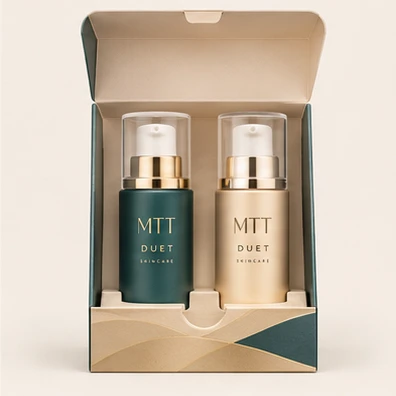
Review the two-pump folding carton alongside your actual components. See the cosmetic packaging specification guide for the dimensions and artwork needed for a quotation.
From guide to product
Explore the opening, material and insert details for each design. These are options to review, not proof of a tested fit for your product.
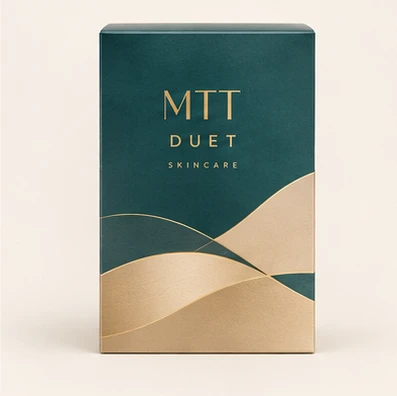
Folding cartons · Tuck-flap carton with folded cradle
Printable paperboard; surface and colour confirmed by sample
View structure & details →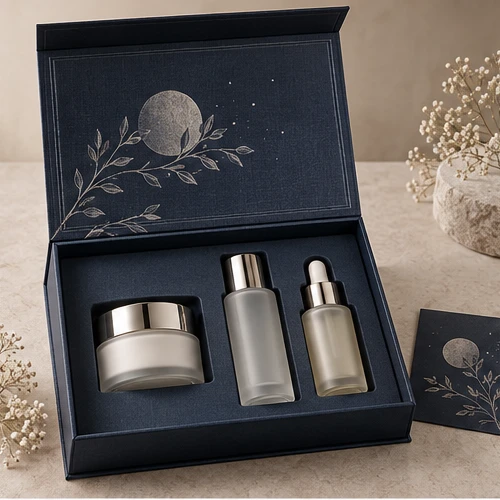
Rigid gift boxes · Magnetic book box
Fine linen-textured wrapping paper
View structure & details →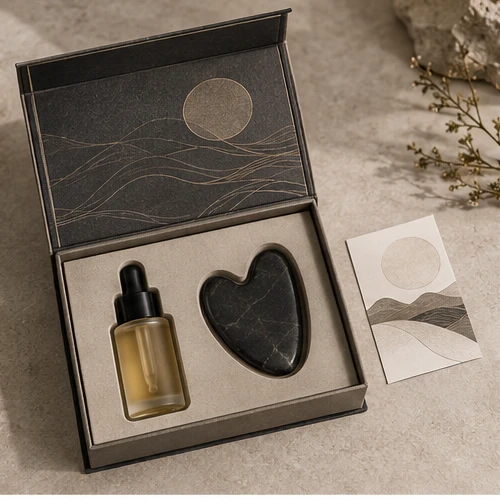
Rigid gift boxes · Magnetic book box
Textured uncoated wrapping paper
View structure & details →Payment Options
Available for confirmed production orders.
Available for eligible payments.
Available payment methods may depend on order value, project stage and transaction arrangements confirmed with MTT Packaging.
 Bank Transfer
 PayPal