Personalized Perfume Sets: Plan the Insert Around Every Combination
Quick answer
A personalised perfume set needs an approved configuration list before a shared insert can be chosen. Compare the smallest, largest and differently shaped assemblies, including caps and accessories. A common outer box with variant inserts may be practical, but it adds packing and stock-control work. Test each distinct support condition rather than extrapolating from one attractive arrangement.
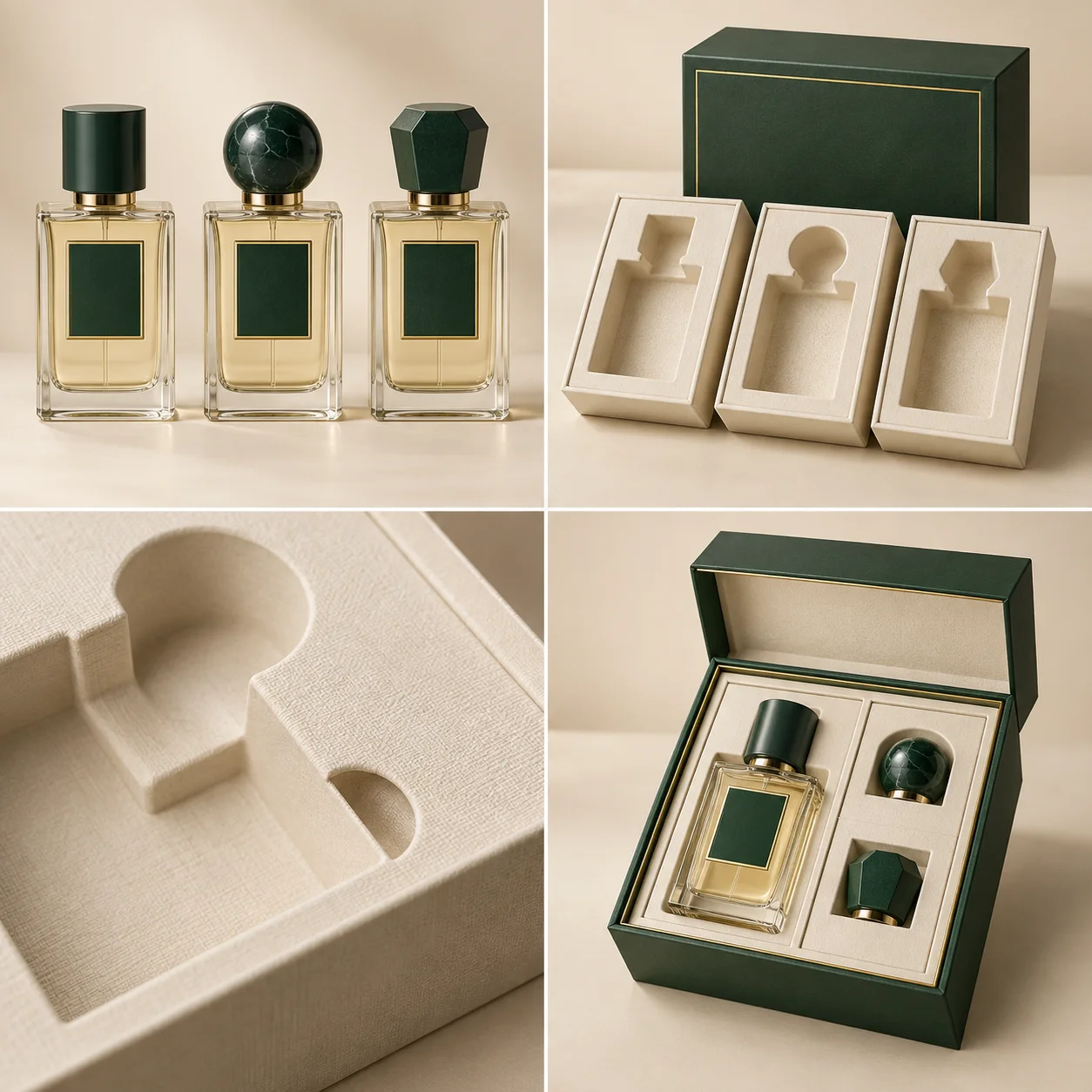
Four stages explain the product requirements, structure and finishing choices. AI-generated visualizations; final construction and finish are confirmed through physical sampling.
01 · Product requirements
Record the size envelope of every approved bottle and cap combination.
02 · Structure direction
Compare a shared outer box with replaceable insert variants.
03 · Materials & finishing
Check the finished cavity surfaces, clearance and finger access.
04 · Complete packaging presentation
Sample the permitted combinations; one assembled render does not prove universal fit.
01
Published reference
The same Avery Dennison feature identifies EDIT (036), by Lavernia & Cienfuegos, as a perfume personalization concept with interchangeable components. It is explicitly a concept reference. No production result or MTT involvement is claimed here. Read the Avery Dennison M_use: EDIT (036) concept.
02
The buyer’s challenge
Personalization increases the number of combinations an insert may need to hold. A cavity developed around one bottle assembly can fail when the stopper, base or accessory changes. Define the allowed configurations before choosing a common box.
03
Structure and material direction: our analysis
Create a dimensional envelope for each assembly and compare a shared outer box with variant-specific inserts. A removable insert component may be worth evaluating, but it adds packing instructions and inventory. Keep the customer’s selection visible in the SKU or pack-out documentation.
04
What to check in sampling
Sample the smallest and largest approved configurations and any shape that introduces a new contact point. Review clearance, movement and removal. A render of one configuration cannot demonstrate that all combinations fit. Do not label a pack universal until its approved scope is documented.
05
Use a configuration matrix at pack-out
Configuration code and fitted cap or base.
Maximum assembled dimensions and filled weight.
Compatible insert revision.
Accessories and label version.
Physical fit check status.
Include shape changes as well as size extremes: the tallest version is not necessarily the hardest to support.
06
Prepare a comparable quotation
Provide a configuration matrix, assembly dimensions, filled weights, quantity by option and accessory list. Request the common outer box and each insert variant as separate items so the effect of personalization is visible. Review bottle support and clearance.
07
Image and project credits
The four-stage images were generated specifically for this analysis. They illustrate a proposed direction and do not show the referenced brand’s packaging. Original project credit belongs to the creators linked above. No affiliation, manufacturing relationship or production performance is implied.
From guide to product
Compare packaging for your brief
Explore the opening, material and insert details for each design. These are options to review, not proof of a tested fit for your product.
 Bank Transfer
 PayPal