In this guide · 3 sections
- Die-cutting tolerances by packaging substrate
- Designing clean tear-strips, euro slots, and window frames
- Coordinating die-cut inserts with the artwork preflight
179 / Die-cutting & tooling production
Quick answer
Every die-cut folding carton, corrugated mailer, or EVA foam insert has real mechanical cutting tolerances set by steel-rule blade gauge and board density—typically ±0.3–0.5 mm on 350 gsm SBS folding cartons, ±1.0–1.5 mm on E/B-flute corrugated sheets, and ±0.5–1.0 mm on die-cut EVA foam. Keep window borders at least 12–15 mm clear of panel edges so die-cut boxes do not buckle, specify clean nick placement away from display typography on perforated tear-strips, and approve a physical die-cut sample before committing mass tooling.
 By Hugo He · Custom Packaging Consultant, MTT Packaging · Updated 2026-11-27

At a glance
Compare packaging die-cutting tolerances: 2 pt vs. 3 pt steel-rule kerfs, perforation nicks, ±0.3–1.5 mm substrate tolerances, and 12–15 mm window borders.
Designer PDF files represent mathematical zero-width lines, whereas factory flat-bed and rotary die cutters press laser-kerfed plywood boards fitted with steel cutting and creasing rules. Compare typical shop tolerances across our core structural families so inserts, flaps, and windows assemble without forcing.
| Material substrate | Typical blade rule | Cut-to-print / dimensional tolerance | Critical mechanical guardrail |
|---|---|---|---|
| Folding carton (350–400 gsm SBS) | 2 pt (0.71 mm) steel rule | ±0.3–0.5 mm register | Keep text ≥3 mm inside creases; window frame ≥12–15 mm wide |
| E-flute / B-flute corrugated | 3 pt / 4 pt heavy rule | ±1.0–1.5 mm across scores | Perforated tear-strips need alternating cut-tie ratios tested loaded |
| Rigid greyboard (1,000–1,200 gsm) | 3 pt / V-groove milling | ±0.5–0.8 mm shell size | V-groove leaves ~0.35 mm bottom hinge skin; test fold tear |
| EVA foam insert (38–45 kg/m³) | High-profile bevel blade | ±0.5–1.0 mm cavity contour | Keep ≥8–10 mm foam bridge between adjacent bottle wells |
On tamper-evident e-commerce mailers or hanging retail cartons, perforation tie-to-cut spacing controls opening force. Too little uncut nick material splits mailers open in parcel conveyors; too wide a tie shreds outer printed wrap when the buyer pulls the zipper tab. Inspect perforation resistance directly on a glued physical dummy for a litho-laminated corrugated mailer or auto-bottom folding carton.
Never design delicate printed borders 0.5 mm parallel to a die-cut edge: natural ±0.4 mm sheet-feed shift makes thin frames visibly off-center across 1,000+ cartons. Coordinate physical tooling checks with our dieline artwork setup guide and artwork preflight checklist, and review our quality control workflow before mass production.
Nicks are tiny 0.4–0.8 mm uncut notches ground into the steel-rule cutting blade. They hold punched-out scrap pieces and carton blanks loosely connected to the press sheet during automatic die-cutting before stripping, preventing jams—though visible paper burrs appear if placed on aesthetic front edges.
Maintain at least 12–15 mm solid paperboard width around any open or PET-patched window cutout on 350–400 gsm folding cartons; narrower bridges tear under stacking compression or warp during gluing.
Because sheetfed die-cut registration can drift ±0.3–0.5 mm against printed ink, add 2–3 mm bleed past window apertures and avoid thin hairlines frames hugging cut edges.
From guide to product
Explore the opening, material and insert details for each design. These are options to review, not proof of a tested fit for your product.

Corrugated packaging · Roll-end mailer
Sheetfed offset CMYK + Pantone spot ink with matte or anti-scuff BOPP lamination
View structure & details →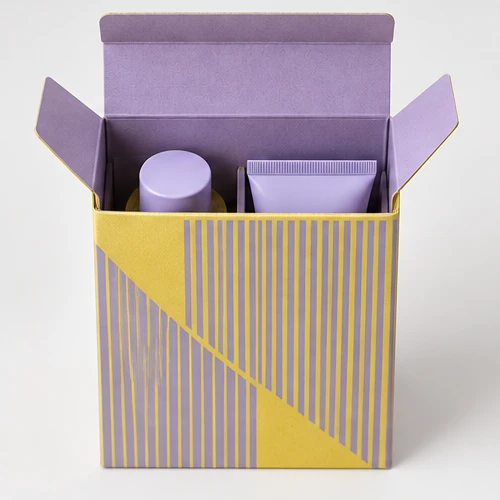
Folding cartons · Crash-lock bottom carton
Direct sheetfed offset CMYK + Pantone spot ink with glue-flap varnish knockout
View structure & details →
Rigid gift boxes · Two-piece rigid box
157 gsm C2S art paper with anti-scratch matte lamination or specialty paper
View structure & details →Payment Options
Available for confirmed production orders.
Available for eligible payments.
Available payment methods may depend on order value, project stage and transaction arrangements confirmed with MTT Packaging.
 Bank Transfer
 PayPal