Does Custom Packaging Need CE Marking? An Artwork Approval Guide
Quick answer
An ordinary empty paper box or shopping bag does not need CE marking merely because it is packaging. CE applies to products covered by specific EU legislation. When a mark is required on the packaged product, whether it also appears on packaging depends on the applicable rules. Obtain product-specific instructions from the responsible manufacturer before printing, and keep those instructions linked to the correct SKU and artwork revision.
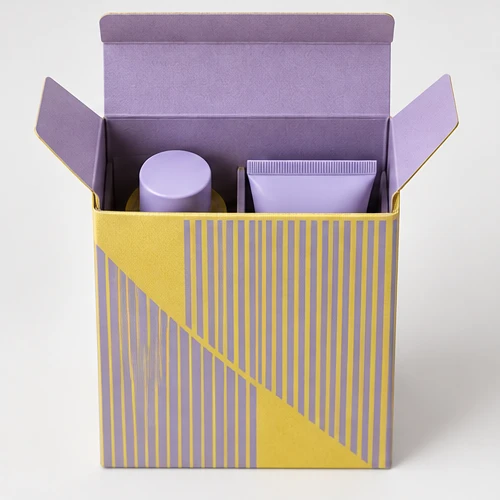
Packaging design reference. Final fit, materials and finish are confirmed on an approved sample.
At a glance
Understand when CE marking belongs on product packaging, who supplies approved compliance artwork and what to check before printing cartons or gift boxes.
Separate the product obligation from the empty box
The EU explains that CE marking is mandatory only for products covered by legislation requiring it, and must not be used on other products. It is not a general quality award for a packaging supplier. Source: Your Europe, CE marking.
A carton for an electrical device and an ordinary cosmetic gift box may have different labelling requirements because of what they contain. Do not transfer a CE symbol from one project to another simply because the same factory prints both. A factory’s equipment documentation also does not establish that its empty boxes are CE-certified.
Start by identifying the product and applicable legislation with the responsible compliance team. If the packaging itself incorporates a regulated function or is supplied as a different kind of product, that classification needs its own assessment. This article addresses artwork coordination, not a conformity assessment for a particular product.
02
Get the compliance decision before designing the panel
The responsible product manufacturer should provide the approved marking instructions and supporting product identification. The EU Blue Guide explains the responsibilities and conformity-marking framework; the product-specific legislation determines the detailed obligations. Source: European Commission Blue Guide, 2022.
Packaging artwork handoff for regulated products
Input
Who should confirm it
Packaging action
Product and SKU
Responsible product manufacturer or compliance team.
Match the artwork to the exact product identity.
Applicable marking
Responsible compliance team.
Place only the approved marks and accompanying information.
Placement and size
Applicable product rules and approved instructions.
Check the flat layout and assembled pack.
Languages and identifiers
Responsible market-compliance owner.
Reserve sufficient readable space.
Final release
Named authorised artwork approver.
Record the approved version before printing.
This handoff does not transfer the manufacturer’s legal duties to the printer. MTT can coordinate the dieline, sample and production artwork; it should not invent a CE declaration or decide that a customer’s product meets technical requirements.
03
Check minimum size without treating it as a universal layout rule
Your Europe states a general minimum CE-marking height of 5 mm unless the relevant product rules provide otherwise. The proportions must be maintained. It also explains that packaging or accompanying documents may be used where product placement is not possible, subject to the applicable requirements. Source: EU marking and placement guidance.
Measure the final artwork at its actual print size. Do not stretch the symbol to fill a narrow panel or assume that printing it on the box always replaces marking the product. Confirm any required accompanying identification separately; the presence of a notified body in a process does not justify adding an arbitrary number.
A printer’s proof should show scale and panel position. After folding or wrapping, check that a seam, sleeve, closure or label does not hide required information. For a drawer box, decide which surface remains accessible in the product’s supplied configuration. These are practical artwork checks, not substitutes for the applicable legal placement rule.
04
Avoid the wrong-SKU failure
Illustrative scenario: a brand sells two similar gift sets, one containing an electronic accessory and one containing only non-electrical items. The design team duplicates the first carton file for the second. A copied compliance panel may now describe the wrong product or carry an inapplicable mark.
Use a product-to-artwork matrix rather than approving by appearance alone. Record SKU, contents, language version, compliance instruction, dieline revision and artwork file. Mark obsolete versions clearly and prevent them from returning to the print queue. If several products share one outer box, confirm the approved way to distinguish the supplied configurations.
The shared-box planning guide covers the structural side of a multi-SKU range. The same efficiency goal must be checked against each product’s information requirements before the artwork is shared.
05
Approve the physical proof and keep the record
Review required text and marks on a representative assembled sample, not only on a flat screen. Check legibility, placement, correct identifiers and whether any added sleeve or sticker changes what the buyer sees. Preserve the approved file and instructions with the order.
Other packaging requirements still need their own assessment. CE is not a shortcut for material restrictions, environmental claims or packaging-waste obligations. The PPWR packaging guide discusses a separate EU packaging topic. Ask the responsible compliance owner to confirm current requirements for the actual product and market before release.
06
Sources and evidence boundaries
Prepared by MTT Packaging editorial. Sources checked on 8 October 2026.
MTT is a China packaging development and manufacturing partner. Credential references in this guide concern the relevant production partner, not certification held by MTT itself. Partner documents, current status and the scope applicable to an order must be checked before making a purchasing or artwork claim. The checklists and scenarios are editorial buying guidance, not published customer results or a certification audit.
From guide to product
Compare packaging for your brief
Explore the opening, material and insert details for each design. These are options to review, not proof of a tested fit for your product.



 Bank Transfer
 PayPal