In this guide · 3 sections
- Follow the L x W x H opening convention
- Compare wall thickness across box families
- Verify loaded headroom and finger clearance
170 / Packaging measurement & structural engineering
Quick answer
Industry packaging standards always list box dimensions in Length × Width × Height (L × W × H) order using internal dimensions in millimeters. Length is the longer side at the opening, Width is the shorter side at the opening, and Height is the vertical depth from opening to base. Never quote external dimensions without specifying board thickness, because 2.0 mm greyboard or 3.0 mm B-flute corrugated walls significantly reduce usable interior space.
 By Hugo He · Custom Packaging Consultant, MTT Packaging · Updated 2026-11-26

At a glance
Measure packaging box dimensions in standard Length x Width x Height order. Compare internal cavity size vs. external dimensions across rigid boxes and cartons.
Under FEFCO and folding-carton drafting conventions, Length and Width define the opening footprint, and Height defines the vertical axis perpendicular to the opening. On a mailer or top-loading rigid box, Length is the longer edge of the mouth; on a side-opening sleeve or drawer box, the sliding mouth sets Length and Width while the sleeve depth becomes Height.
Mixing up Width and Height on a quotation changes which panel carries the glue flap, lid hinge, or flute direction. Always label each axis on a quick sketch alongside our internal versus external dimension checklist.
| Box family | Typical wall thickness | Internal-to-external difference (both walls) | Key allowance rule |
|---|---|---|---|
| Folding carton (350 gsm SBS) | 0.45–0.55 mm | +1.0–1.2 mm | Account for dust-flap fold-in at top/bottom mouths |
| Rigid box (1,200 gsm greyboard) | 1.9–2.2 mm | +4.0–4.5 mm (base); +8–9 mm (with lid) | Specify base inner cavity separate from outer lid envelope |
| E-flute mailer | 1.5–1.8 mm | +5.0–7.0 mm (double-wall fold) | Roll-end front/side locks double the wall thickness |
| B-flute shipping carton | 2.8–3.2 mm | +6.0–7.0 mm | Score-to-score manufacturing tolerance is ±1.5–2.0 mm |
Internal height must clear the tallest cap, dropper bulb, or folded pouch plus any lid-mounted card pocket. Add 2–3 mm vertical headroom on rigid boxes and leave 10–15 mm finger-pull notches beside heavy glass jars so buyers do not invert the box to remove the product. Test your target dimensions in our box size calculator before requesting a physical sample.
Packaging suppliers and FEFCO standards list dimensions as Length (longer opening side) × Width (shorter opening side) × Height (vertical depth from opening to base), always measured on the inside.
Always specify internal dimensions based on your filled product and insert, or clearly label external dimensions when matching an outer shipping carton or retail shelf limit.
A 1,200 gsm greyboard rigid box with wrap paper adds roughly 2.0–2.2 mm per wall (4.0–4.4 mm across the total width or length), plus lid overlap on two-piece telescoping boxes.
From guide to product
Explore the opening, material and insert details for each design. These are options to review, not proof of a tested fit for your product.
Rigid gift boxes · Magnetic book box
157 gsm matte-laminated C2S art paper or 120 gsm dyed specialty paper
View structure & details →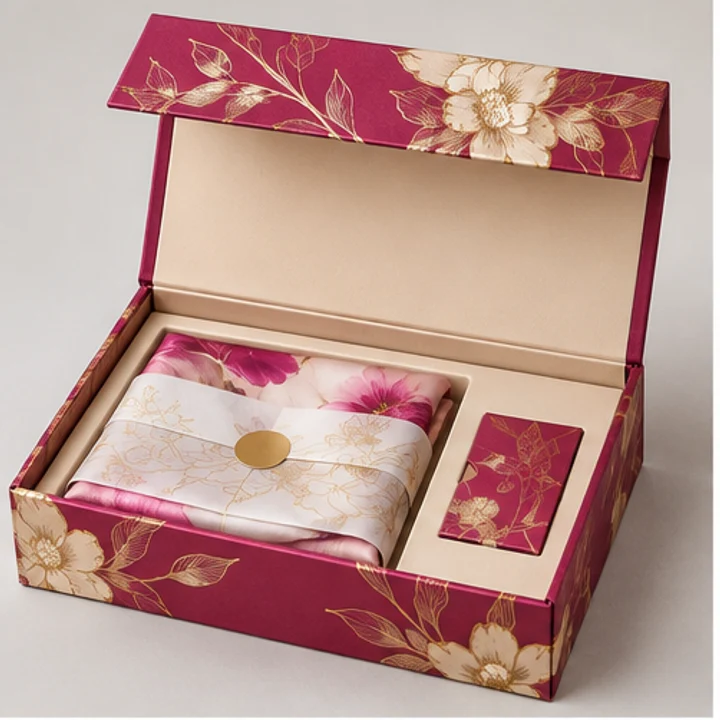
Rigid gift boxes · Two-piece rigid box
157 gsm C2S art paper with anti-scratch matte lamination or specialty paper
View structure & details →
Rigid gift boxes · Lift-off lid
Gloss-laminated printed wrapping paper
View structure & details →Payment Options
Available for confirmed production orders.
Available for eligible payments.
Available payment methods may depend on order value, project stage and transaction arrangements confirmed with MTT Packaging.
 Bank Transfer
 PayPal